
Why Snowflake CoWork Needs a Customer Context Layer
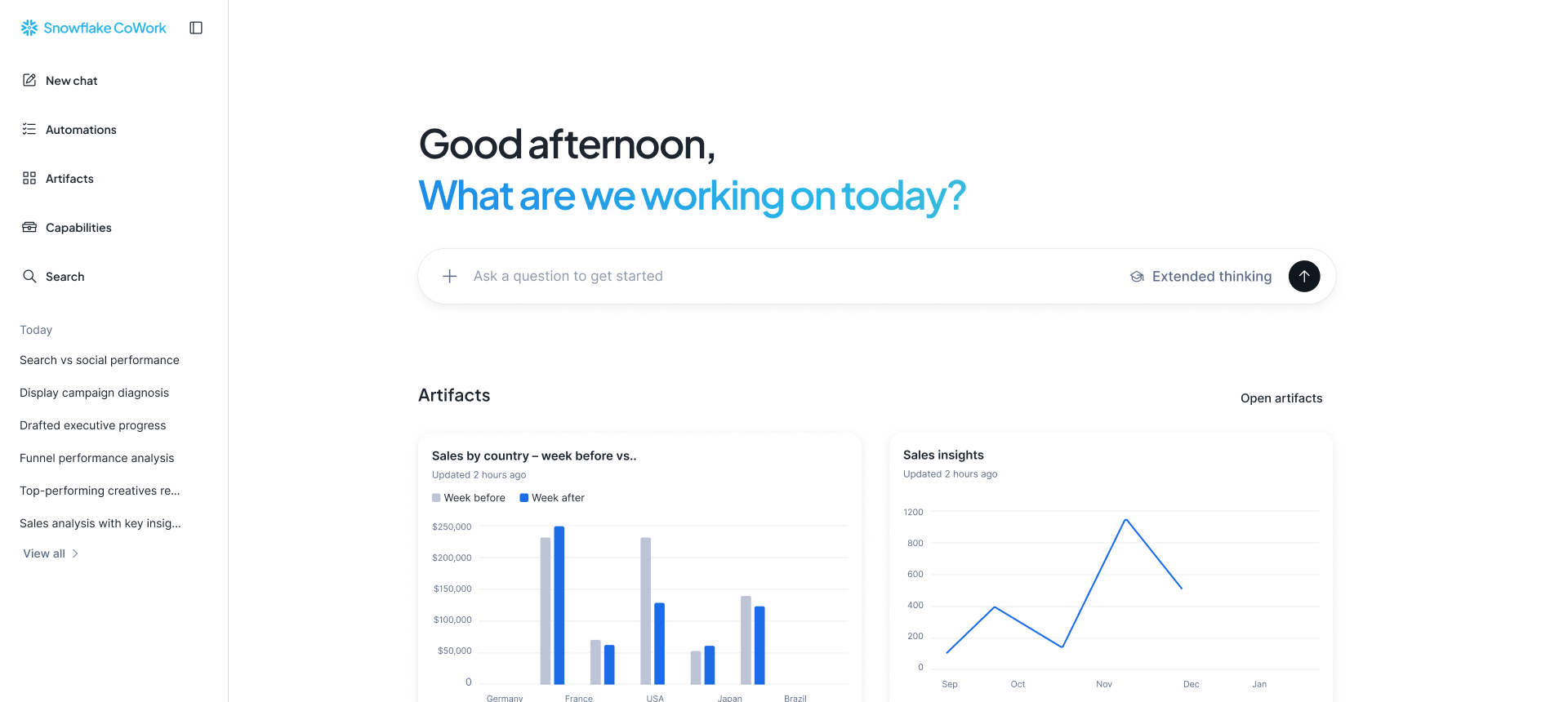
At this year's Snowflake Summit, Snowflake renamed Snowflake Intelligence to Snowflake CoWork. They also previewed Cortex Sense alongside it.
The rename was the smaller news.
The bigger news is in Snowflake's own framing of Cortex Sense. They refer to it as a "shared context layer that agents can use immediately." This means the same context layer feeds both Snowflake CoWork (the proactive personal work agent for knowledge workers) and Snowflake CoCo (the coding agent). So you end up with one foundation and multiple agents on top.
And this is the exact shape of the argument we've been making for months. An agent is only as good as the data powering it, and a good context layer feeds more than one agent.
If you're a Snowflake customer, you may have read this announcement and thought "great, we're covered." Hold that thought.
Cortex Sense is absolutely the right shape of foundation for enterprise data. But when it comes to customer data, it's only as good as the customer data feeding it. And most Snowflake users aren't feeding it customer data fit for AI agents.
So, we figured we'd write this post to explain what Cortex Sense is great at, what it can't fix on its own, and what your stack needs to ground both Snowflake CoWork and the customer-facing AI agents now arriving in your stack.
What Snowflake CoWork actually is now
Snowflake CoWork is the personal agent experience for knowledge workers. The headline positioning is "from reactive insights to proactive action."
Under the hood, CoWork functions as the user-facing application layer, calling upon a powerful suite of underlying execution engines inside Snowflake’s secure perimeter: Cortex Analyst handles structured data, Cortex Search handles unstructured text content, Cortex Knowledge Extensions pull in external sources, and Cortex Agents orchestrate the multi-step loops needed to execute complex tasks.
But what makes these capabilities actually mesh seamlessly is Cortex Sense. Rather than sitting inside CoWork as a standalone feature, Cortex Sense lives underneath the application layer as a global, shared context infrastructure. Think of it as a central "brain," that automatically learns your company's unique business definitions, schemas, and table relationships using ambient metadata and query logs. From there, it feeds that institutional understanding directly into both Snowflake CoWork (for business users) and Snowflake CoCo (the developer coding agent) so every tool across the estate operates from the exact same playbook.
What's new in this release:
- Deep Research for multi-step reasoning across structured and unstructured enterprise data. Snowflake claims it outperforms single-agent systems by over a third on the Hybrid Deep Research Benchmark.
- Artifacts — publishable governed dashboards you can explore through conversation.
- User Skills and the Skill Catalog for reusable workflows shared across the team.
- User Memory so CoWork learns how you work over time.
- MCP connectors into Gmail, Google Drive, Salesforce and Slack.
- iOS app, Slackbot, Excel extension for wherever the work happens.
Over 13,900 customers already trust Snowflake with their data. Synopsys, WHOOP and Under Armour are the named Snowflake CoWork early adopters in the announcement. Synopsys alone has built more than 20 purpose-built agents on Snowflake.
Snowflake just made the foundation argument louder
We've been talking a lot about the need for rich, real-time context for AI agents. The Cortex Sense framing is the strongest external validation this conversation has had. So we're going to use Snowflake's own words.
Cortex Sense brings together "the data, business definitions, and operational knowledge that AI agents need to be trustworthy and useful." It works for both Snowflake CoWork and Snowflake CoCo. One context layer, two agents on top of it. It ships with prebuilt plugins for finance and sales that combine skills, business logic and MCP connectors so teams can deploy production-ready agents grounded in operational knowledge from day one.
This is absolutely the right shape of foundation for any enterprise data that's already in your Snowflake warehouse. Cortex Sense brings the definitions, relationships, and operational knowledge AI agents need to reason over what's there, including customer data when the customer data is clean.
But there's a catch.
Snowflake CoWork is now proactive, meaning it takes action through MCP, runs in the background, checks for anomalies overnight, and pings you on Slack before the week starts.
The richer the action, the richer the data underneath has to be. And Cortex Sense is only as good as what arrives in the warehouse.
Unfortunately, this is where many Snowflake customer-data stacks fall apart. Here's what we mean by this:
You might look at your stack and see customer data flowing into your warehouse. You might have events from a CDP, GA4 exports running through BigQuery into Snowflake, or reverse-ETL'd CRM data. You may also have marketing automation exports from your marketing automation tool. Your pipes are in place, the tables are loading, the dashboards are running. So you'd think in this scenario Cortex Sense can reason over all of that and feed CoWork the customer context it needs, right?
Well, not quite.
For many Snowflake customers, the data feeding CoWork from those sources often has problems Cortex Sense can't fix downstream.
- Schema drift. While Cortex Sense is brilliant at learning semantic definitions and query patterns, without validation at collection, fields change, types shift, and raw events break. If the foundation is noisy, the underlying engines are forced to learn from corrupted data, and downstream agent accuracy degrades.
- Post-hoc identity. Identity gets stitched together in the warehouse after the fact, usually via fragile joins on email or cookie ID. A customer on three devices looks like three customers until the next processing job runs.
- Pipeline latency. Even with Snowflake's impressive real-time ecosystem (like Snowpipe Streaming), raw behavioral data still must be processed, transformed, and modeled before it is ready for AI. For sub-second, in-session personalization, standard warehouse pipelines struggle to keep pace with the live customer session.
- No live consent state. Snowflake Horizon is excellent at dynamic masking and row-level filtering once data arrives, but capturing live client-side consent and perfectly pairing it with every behavioral event in transit remains a complex gap. Without it, there's a compliance risk on every rapid action a proactive agent takes.
- No behavioral depth. CRM and marketing automation data tells CoWork who the customer is. It doesn't tell it what the customer just did.
Why is this an issue? Well, an agent firing actions on customer data with any of these gaps doesn't just fail loudly, it fails slowly. The renewal-save email goes to someone who churned on Saturday. The personalization lands on a customer who just bought the thing being recommended. The at-risk Slack alert points at the wrong account because the identity graph is two days old. Each miss costs you a renewal, a refund, and a potential reputation hit. And every miss makes the next data architect more reluctant to give an agent any real authority.
This is the gap a customer context layer closes. Schema validated at collection. Identity resolved in stream, not after the fact. Behavioral signal streamed into the warehouse in real time, with consent attached at every step. Snowplow is that layer.
Snowplow is the customer context layer in your Snowflake stack
Snowplow is the real-time customer context layer. It feeds Cortex Sense the clean customer data it needs so Snowflake CoWork answers customer-data questions reliably for the knowledge workers who depend on it. It also runs a real-time path for the customer-facing AI agents that can't wait for the warehouse.
Snowplow's architecture consists of a layer with two consumption modes. One into Snowflake (raw events → dbt models → Cortex Analyst semantic view → Cortex Sense → Snowflake CoWork).
And another direct to customer-facing agents via Snowplow Signals in real time.
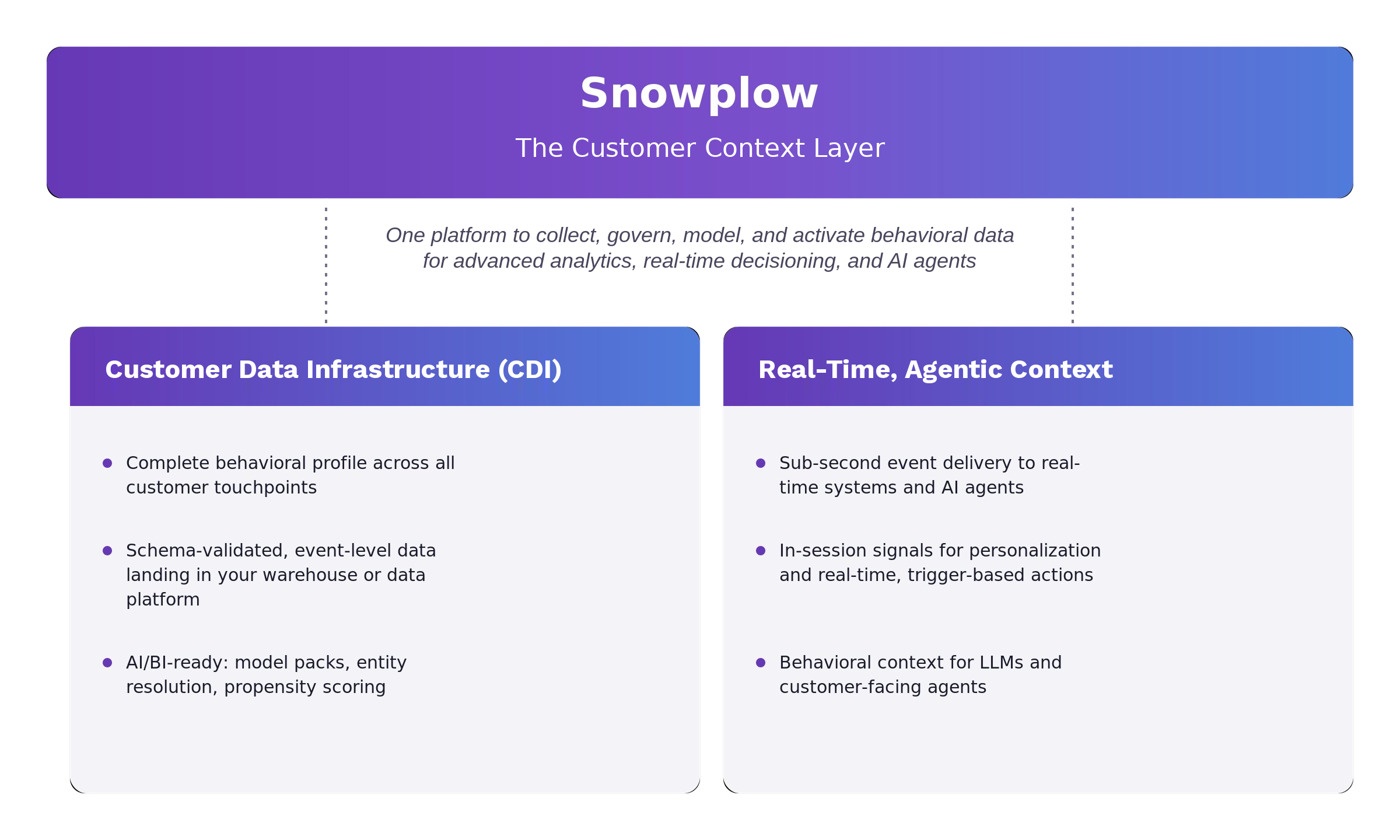
Inside the layer you have:
- Behavioral events validated against schemas at the point of collection
- Identities resolved in stream, before the data lands in the warehouse
- Customer profiles built from those events
- Consent state captured per event and propagated through the layer
For your Snowflake warehouse, the layer delivers data that's already validated, identity-resolved, and consent-aware by the time it lands. Cortex Sense reasons over it with the same accuracy it gets on the enterprise side. And CoWork answers customer-data questions you can trust.
For customer-facing agents that can't wait for the warehouse, the same layer runs a real-time path through Snowplow Signals.
The more operational Snowflake CoWork gets, the higher the table stakes on the data underneath. Answering "what happened?" off bad data is awkward. Acting on "what should happen next?" off bad data is expensive. If we take Synopsys as an example, they've built 20+ purpose-built agents on Snowflake. And every one of them needs context it can trust.
We've published the practical setup end to end in our Snowplow + Snowflake CoWork blueprint.
How Snowplow and Cortex Sense fit together
So here's where the piece earns its title.
Cortex Sense and the customer context layer aren't the same thing. Cortex Sense helps Snowflake's agents make sense of whatever's in the warehouse, whether that be business definitions, table relationships, or operational knowledge.
The customer context layer is what makes sure the customer data in your warehouse is accurate to begin with. It validates data at collection, resolves identity, and is consent-aware. And for the customer-facing AI agents that can't wait for the warehouse, the customer context layer runs a real-time path on top.
Snowplow doesn't replace Cortex Sense. The customer context layer is what makes Cortex Sense work properly on customer data.
Two layers. Two consumption modes. Multiple agents.
Cortex Sense makes Snowflake CoWork trustworthy on your enterprise data, whether sitting in the warehouse or pulled via MCP connectors, provided that data arrived clean. But managing high-volume, sub-second behavioral event streams for external customer-facing agents often requires a dedicated real-time pipeline operating alongside standard analytics architectures.
If you'd like the bigger argument, our cornerstone piece on what a customer context layer is walks through the six principles.
What the customer context layer adds
In addition to your Snowflake stack, a customer context layer like Snowplow provides three additional things:
- Shift-left data quality. Snowplow validates at collection. By the time Snowflake CoWork or a customer-facing agent reads the data, the quality bar is already met. Cortex Sense reasons over what arrives. The customer context layer decides what arrives.
- Behavioral and identity-resolved coverage, including agents acting on customers' behalf. Web, mobile, server-side, plus the AI agents now researching and transacting on customers' behalf.
- Real-time, information-dense context. What customer-facing agents need and what standard analytics pipelines into the warehouse might struggle to deliver for sub-second, in-session use cases. Snowplow Signals is how that arrives.
This gives you two stages in the stack, not two versions of the same thing. Snowplow produces the customer behavioral data. Snowflake holds it. Cortex Sense gives CoWork the context to reason over it. And Snowplow Signals runs alongside for the customer-facing agents that can't wait for the warehouse.
Where this leaves you
Snowflake Summit '26 made the foundation argument even louder. Cortex Sense is Snowflake's enterprise context layer for its agents. That's a completely new way of working with whatever data lives in your warehouse, and a fair claim, provided the data that lives there is right.
The customer-data slice is a different layer with different requirements. Snowplow is that layer.
Together, the two layers turn Snowflake CoWork from a Q&A tool into a system of action grounded in trustworthy enterprise data and trustworthy customer data alike. And the customer context layer underneath extends that same foundation to the customer-facing AI agents your product team is now being asked to ship alongside it. All aimed at the business outcomes that justified the agent rollout in the first place.
If you'd like to see how this works in practice, our Snowplow + Snowflake CoWork blueprint walks you through the end-to-end setup. If you'd like the bigger argument, our customer context layer cornerstone is where the series starts.