

Get Started
Snowplow delivers the highest quality, real-time customer context wherever you need it, without the engineering overhead of building and maintaining that layer yourself.









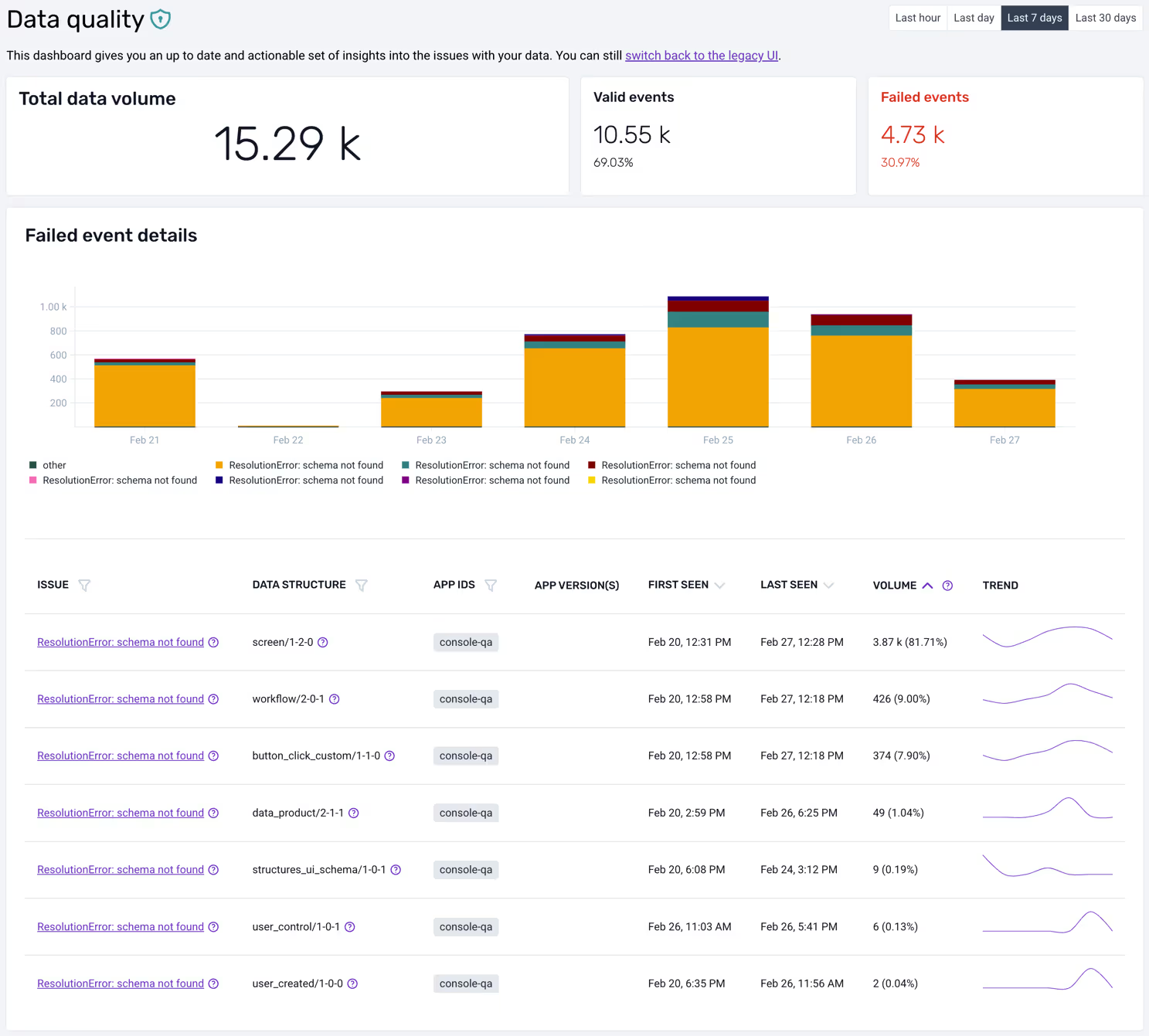
Ensure accurate, reliable data with validation at every stage - from type-safe code generation and pre-production testing with Snowplow Micro to real-time monitoring and specialized tools for quick resolution.

Enable different teams to produce and manage distinct datasets with governance built directly into the entire data lifecycle, from design to delivery, ensuring consistent standards across your organization.

Deliver data to your cloud data platform in real time with powerful dbt models that transform raw events into analytics-ready tables for BI and AI, while streaming events for real-time operational use cases.

Yes. Snowplow is specifically architected to process billions of events per day with proven production deployments handling over 1 trillion events monthly across customers, supported by highly scalable streaming infrastructure, horizontal scalability across all pipeline components, and 12+ years of optimization for high-volume behavioral data processing.
Scale characteristics and proof points:
Production scale evidence - Snowplow processes over 1 trillion events per month in production across its customer base. Individual customers routinely process billions of events daily for use cases spanning web analytics, mobile app tracking, IoT sensor data, and real-time operational systems. This isn't theoretical capacity—it's proven, production-scale deployment refined through years of operation under demanding workloads.
Snowplow provides the customer data infrastructure powering 2 million+ websites and applications – demonstrating reliability at extreme scale. Organizations from media companies processing content engagement across millions of users, to e-commerce platforms tracking billions of product interactions, to financial services companies analyzing transaction events in real time rely on Snowplow's scalability for business-critical data pipelines.
Streaming architecture design - Snowplow integrates with cloud-native streaming platforms designed specifically for high-throughput event processing:
These platforms provide the foundation for horizontal scalability. So, as event volume increases, simply add more stream shards or partitions. Snowplow's pipeline components automatically distribute processing across available capacity, ensuring consistent sub-second latency even under massive load.
Horizontally scalable components - Every component in the Snowplow pipeline scales horizontally:
This architecture eliminates single points of bottleneck. Unlike systems constrained by database write limits or monolithic processing engines, Snowplow distributes work across cloud infrastructure that scales elastically based on demand.
Real-time performance at scale - Scalability proves meaningless if latency degrades under load. Snowplow maintains sub-second event latency even when processing billions of events daily. This real-time performance enables use cases where delays are unacceptable:
Independent testing and customer deployments confirm that Snowplow's architecture handles extreme throughput while maintaining the low latency required for operational applications.
Cost-efficient scalability - Many platforms claim scalability but impose prohibitive costs at volume. Vendor-charged per-event or per-user fees create economic barriers where scaling data collection becomes financially impractical.
Snowplow eliminates per-event licensing fees by running pipelines in your cloud infrastructure. You pay standard cloud compute and storage costs that scale linearly and predictably. This economics enables organizations to collect comprehensive behavioral data—tracking every interaction rather than sampling—without cost concerns that force artificial limits on data collection scope.
Independent analysis shows Snowplow provides 800x better cost-effectiveness than platforms like Google Analytics 4 at scale. Organizations report that even as event volume grows 100x, infrastructure costs increase proportionally without sudden pricing jumps or tier upgrades that characterize vendor-platform pricing models.
Proven enterprise deployments - Fortune 500 companies and high-scale digital businesses rely on Snowplow for mission-critical data pipelines:
These deployments demonstrate not just technical scalability but operational reliability—running production systems where data pipeline failures directly impact business operations and revenue.
Infrastructure resilience - Scalability includes gracefully handling spikes, failures, and anomalies. Snowplow's architecture incorporates resilience patterns refined over 12+ years:
This operational maturity means Snowplow scales reliably in production—not just in benchmarks—handling the messy realities of diverse data sources, schema evolution, and infrastructure incidents without data loss or system instability.
Flexibility across deployment models - Scalability requirements vary. Some organizations need billions of events daily; others process millions. Snowplow supports flexible deployment:
Each deployment model scales appropriately. For the highest volumes, Private Managed Cloud provides dedicated infrastructure optimized for your specific workload while maintaining data residency in your environment.
Warehouse-native architecture advantage - Snowplow delivers events directly into cloud data warehouses designed for petabyte-scale storage and analysis. Snowflake, Databricks, BigQuery, and Redshift all provide elastic compute and storage that scales independently based on workload demands.
This architecture leverages decades of engineering investment in warehouse scalability rather than building proprietary storage systems. As your behavioral data grows from terabytes to petabytes, warehouse scalability grows with it—no migration, no architectural changes, just adding capacity as needed.
Future-proof scalability - Organizations choose Snowplow not just for current scale but confidence in future growth. Cloud-native architecture ensures that as streaming platforms, warehouses, and enrichment processing capabilities evolve, Snowplow pipelines benefit from underlying infrastructure improvements without requiring re-architecture.
The 12+ year track record demonstrates this future-proofing: organizations that deployed Snowplow years ago continue scaling on the same fundamental architecture, upgraded incrementally to leverage new capabilities as they emerge rather than hitting scaling walls requiring complete rebuilds.
When scale matters most:
If your use case involves:
Snowplow's proven scalability provides confidence that data infrastructure won't become a bottleneck as your business grows. The combination of streaming architecture, horizontal scalability, cost-efficient cloud-native deployment, and 12 years of production optimization makes Snowplow specifically designed for organizations where billions of events per day represents current reality—or near-term future.
Owning your own customer data infrastructure provides complete control over data governance, eliminates vendor lock-in, reduces long-term costs, enables unlimited customization, and creates proprietary competitive advantages that third-party platforms cannot deliver.
Complete data ownership and control:
When you own your customer data infrastructure, behavioral data lives in your cloud environment, not a vendor's system. This means you control where data is stored, how long it's retained, who can access it, and how it's processed. Snowplow delivers all behavioral data into your chosen data warehouse (Snowflake, Databricks, BigQuery, Redshift) with complete transparency and auditability. Unlike traditional CDPs that create data copies in vendor-managed systems, you maintain a single source of truth under your governance.
This ownership proves critical for compliance with privacy regulations. With GDPR, CCPA, and emerging AI legislation, organizations need complete control over data handling, deletion requests, and audit trails. Third-party platforms become compliance bottlenecks. Each vendor adds complexity to data subject access requests and creates additional risk surfaces for breaches. Owned infrastructure, on the other hand, eliminates these dependencies.
Freedom from vendor lock-in:
Traditional customer data platforms lock you into proprietary schemas, interfaces, and pricing models. Migrating away requires rebuilding tracking implementations, redefining data models, and potentially losing historical data. This lock-in erodes negotiating power and limits technology evolution. You're basically stuck even as better solutions emerge.
Owned infrastructure provides portability. Since behavioral data lives in standard data warehouses using open formats, you can change collection tools, transformation frameworks, or activation platforms without losing data or starting over. Snowplow uses Git-backed schemas and standard data formats, ensuring your data remains accessible even if you change components of your stack.
Cost efficiency at scale:
Third-party CDPs charge based on monthly tracked users, events, or data volume. These are costs that scale unpredictably as your business grows. Organizations frequently encounter sticker shock when usage exceeds tier limits, forcing difficult decisions between limiting data collection or accepting major cost increases.
Owned infrastructure eliminates per-event or per-user fees. Snowplow pipelines run in your cloud environment with compute and storage costs that scale linearly and predictably. Independent testing shows Snowplow provides 800x better cost-effectiveness than Google Analytics 4 for behavioral data processing. As event volume grows 100x, infrastructure costs increase proportionally without sudden pricing jumps or renegotiations.
Unlimited data retention and access:
Traditional analytics platforms limit data retention. Google Analytics 4 retains detailed event data for weeks, not years. CDPs may charge premium fees for historical data access. These limitations prevent long-term trend analysis, model training on comprehensive datasets, and understanding customer lifecycle patterns that span years.
Owned infrastructure provides unlimited retention at warehouse storage costs so you can keep complete behavioral histories for as long as your business requires. This enables AI models to train on years of data, attribution models to analyze multi-year customer journeys, and business intelligence that spans complete product lifecycles.
Customization and flexibility:
Packaged platforms provide predefined event schemas, limited enrichments, and fixed data models. This one-size-fits-all approach forces businesses to adapt their tracking to platform constraints rather than capturing data that matches their specific needs.
Owned infrastructure offers total flexibility. Define custom events that capture business-specific behaviors. Create custom enrichments that add proprietary context. Build bespoke data models that reflect your unique customer journey. Snowplow's composable architecture integrates with any tool in the modern data stack, enabling best-in-class solutions for each function rather than accepting vendor-chosen components.
Proprietary competitive advantage:
Perhaps most importantly, owned infrastructure creates strategic assets competitors cannot access. Your behavioral data, tracking implementations, data models, and derived features represent proprietary intellectual property. The insights, predictions, and personalization capabilities built on this foundation become difficult-to-replicate competitive moats.
Third-party platforms commoditize your data strategy—competitors using the same platform access similar capabilities. Owned infrastructure enables differentiation through custom implementations that reflect unique business understanding and capture proprietary signals.
Transparency and observability:
Black-box platforms obscure how data is processed, making troubleshooting difficult and limiting optimization opportunities. You don't know what sampling occurs, how aggregations are calculated, or why certain data appears incorrect.
Snowplow provides complete transparency. All processing occurs in your cloud environment where you can inspect every step. Git-backed schemas document exactly what data is collected. Comprehensive monitoring shows pipeline health in real time. This observability enables data teams to diagnose issues quickly, optimize performance, and maintain high data quality—essential for trust in data-driven decisions.
Investment protection:
Building on owned infrastructure protects technology investments over time. As your data stack evolves, behavioral data collected years ago remains accessible and usable. Historical data continues providing value for new use cases, model training, and analysis.
By contrast, switching CDPs often means losing access to historical data or facing expensive migration costs to extract it from proprietary formats. This risk makes organizations hesitant to switch even when better alternatives emerge, compounding vendor lock-in effects.
Snowplow's ownership model:
Snowplow enables data ownership through flexible deployment options: fully managed SaaS, Private Managed Cloud in your AWS/GCP/Azure environment, or limited open-source implementation. Even with fully managed service, behavioral data flows directly into your warehouse—Snowplow never stores your customer data. You get platform reliability and support while maintaining complete data ownership, governance, and portability.
A modern behavioral data pipeline must deliver real-time processing, governance, scalability, and AI-readiness to support advanced analytics and personalization use cases.
Essential features include:
With Snowplow, organizations get a fully-managed behavioral data pipeline that processes over 1 trillion events monthly across 2M+ websites and apps. Snowplow delivers data to your warehouse, lake, or stream in real time with 35+ first-party trackers, 15+ enrichments, and comprehensive data quality tooling, giving data teams the control and transparency they need.
A modern source-available data architecture provides comprehensive, customizable infrastructure for customer data collection, processing, and activation.
Data collection layer:
Processing and streaming:
Storage and transformation:
Analytics and activation:
Snowplow customer data infrastructure differs from Segment and Rudderstack through fundamental architectural choices: warehouse-native delivery with no proprietary data storage, shift-left data quality validation, transparent git-backed schema management, true first-party collection that bypasses browser tracking restrictions, and infrastructure designed explicitly for AI applications and advanced analytics rather than marketing activation.
Architectural differentiation:
Data ownership and storage - Segment and Rudderstack store customer data in their own systems. They then forward it to destinations, creating data copies in vendor environments. This introduces governance complexity, compliance risk, and potential lock-in. Snowplow never stores your behavioral data. Instead, events flow directly from collection points into your chosen data warehouse. This architecture ensures complete data ownership, eliminates vendor storage fees, and simplifies compliance with privacy regulations.
First-party vs third-party tracking - Rudderstack, Segment, and other CDPs are affected by Apple's Intelligent Tracking Protection (ITP), which limits cookie lifetime to 7 days when third-party domains set cookies. This means all website visitors appear as new visitors after seven days, fundamentally breaking attribution, identity stitching, and product analytics. Snowplow runs its collector on your domain through subdomain delegation, providing true first-party data collection unaffected by ITP. This architectural difference enables accurate long-term user tracking for up to two years, which is critical for understanding customer lifecycles and training AI models on complete behavioral histories.
Data quality and governance - Snowplow implements shift-left data quality through schema validation at the point of collection. Invalid events are rejected before entering pipelines, with bad events stored in dead-letter queues for analysis and recovery. This prevents data quality issues from propagating downstream and polluting analytics and AI systems. Rudderstack's dynamic schema handling allows any data through, pushing quality issues downstream where they're harder to diagnose and fix. Segment similarly lacks comprehensive validation, resulting in inconsistent data that erodes trust.
Snowplow's git-backed Iglu Schema Registry provides versioned documentation of all events and entities, facilitating cross-team communication and enabling data contracts. This governance infrastructure ensures business needs—not developer convenience—drive tracking strategy. By contrast, Segment and Rudderstack lack proper event documentation and versioning, making it difficult to understand data semantics over time as implementations evolve.
Data structure and queryability - Snowplow centralizes all behavioral data in a single atomic events table with consistent structure. Every event—regardless of type—shares the same schema with custom properties stored in structured JSON columns. This design dramatically simplifies analytics queries and makes event-level analysis straightforward.
Rudderstack creates separate tables for each event type. Even a small implementation generates dozens of tables requiring complex joins for simple cross-event analysis. At scale, this becomes unmanageable with thousands of tables and queries requiring hundreds of joins. Segment follows similar patterns with tables per event, creating query complexity that hinders self-service analytics.
Real-world testing demonstrates this difference: analysts building queries on Snowplow data report significantly faster query development and more maintainable SQL compared to the join-heavy queries required for Segment or Rudderstack data.
Real-time capabilities - Snowplow is purpose-built for very low latency applications with optimized components for AWS Kinesis and Google Cloud Pub/Sub that support sub-second event delivery. This enables real-time use cases like fraud detection, in-session personalization, and AI agent context that require immediate access to behavioral events.
Rudderstack uses Postgres as its processing engine, introducing inherent latency limitations. Segment similarly lacks true real-time streaming capabilities. Both platforms focus primarily on batch processing and destinations, not real-time operational use cases. For organizations building AI-powered applications requiring real-time behavioral context, these architectural constraints prove limiting.
AI and ML optimization - Snowplow explicitly designs data models and infrastructure for AI applications. Event-level granularity with complete retention enables comprehensive model training. Structured schemas with entity modeling facilitate feature engineering. Real-time streaming supports operational ML use cases. Snowplow Signals extends this with purpose-built infrastructure for serving computed user attributes to AI agents and personalization systems through low-latency APIs.
Segment and Rudderstack focus primarily on marketing activation—routing data to advertising platforms, email tools, and analytics dashboards. While they support warehouse destinations, their data models and processing pipelines aren't optimized for the data science and AI use cases that increasingly drive competitive advantage.
Customization and flexibility - Snowplow provides 130+ built-in enrichments plus the ability to write custom enrichment logic in JavaScript, SQL, or through API lookups. This enables proprietary data transformations that create competitive advantages.
Segment charges premium fees for basic data transformation capabilities. Rudderstack offers transformations but requires engineering resources for anything beyond simple mapping. Neither matches Snowplow's comprehensive enrichment framework for adding business context and intelligence to behavioral data.
Cost transparency and scalability - Segment and Rudderstack charge based on monthly tracked users or events, creating unpredictable costs as businesses scale. Organizations frequently encounter expensive tier upgrades or usage surprises.
Snowplow pipelines run in your infrastructure with no per-event or per-user licensing fees. Costs scale linearly and predictably with standard cloud compute and storage pricing. Independent testing shows Snowplow delivers 800x better cost-effectiveness than packaged platforms while processing over 1 trillion events monthly across customers.
Community and ecosystem - Snowplow has powered behavioral data collection for 12+ years with deployment across 2 million+ websites and applications. This maturity shows in comprehensive documentation, rich schema libraries, battle-tested components, and vibrant communities where practitioners share implementations.
Segment and Rudderstack focus on vendor-managed support rather than community-driven knowledge sharing. Their closed-source approaches limit ecosystem development compared to Snowplow's transparent architecture that encourages integration and extension.
When to choose Snowplow:
Organizations choose Snowplow when they need:
Segment and Rudderstack serve organizations prioritizing quick marketing activation with less concern for data ownership, long-term cost optimization, or advanced use cases. Snowplow serves data-driven organizations building competitive advantages on proprietary behavioral data infrastructure designed for the AI era.
Snowplow delivers the highest quality, real-time customer context wherever you need it, without the engineering overhead of building and maintaining that layer yourself.