Blog
Snowplow Signals is Now Generally Available: Real-Time Customer Intelligence for AI-Powered Applications
Trigger real-time, personalized interactions at key customer journey moments that drive conversions, retention, and engagement.
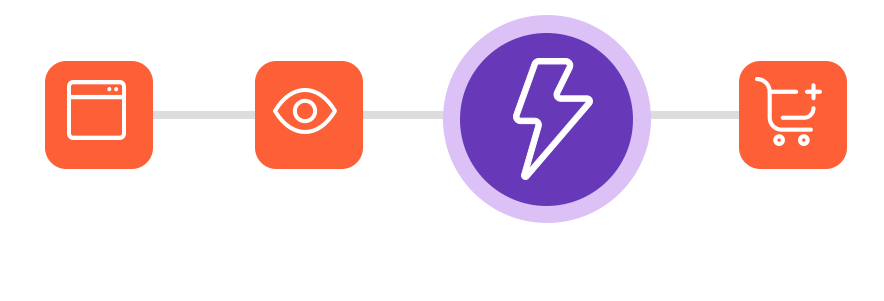

Compute and react to customer signals across your full event-stream in real time, defining custom triggers based on attributes to identify perfect engagement moments.

Trigger actions using machine learning or rule-based conditions to act early in customer journeys, making a meaningful difference and preventing churn and frustration.

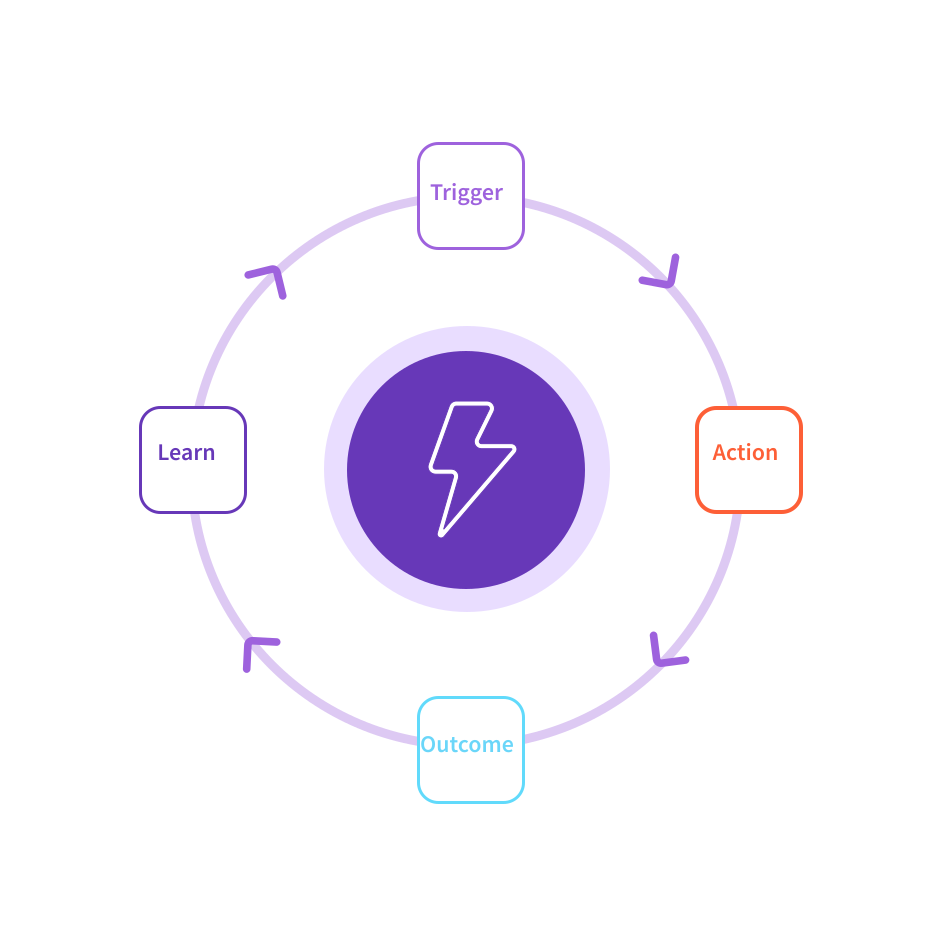
Automatically log and measure every real-time trigger and outcome, creating a continuous feedback loop that helps refine decision logic and maximize effectiveness.
Deliver real-time notifications directly into your customer-facing applications via server-side events when customers need assistance. Identify key moments where customers can’t find what they need, are torn between choices, or getting frustrated with workflows. Take immediate in-app action to support customers before churn occurs.

Engage customers with timely, personalized actions
Define ML-powered or rules-based triggers with complex conditions
Identify opportunities for conversion, retention, and growth in real time
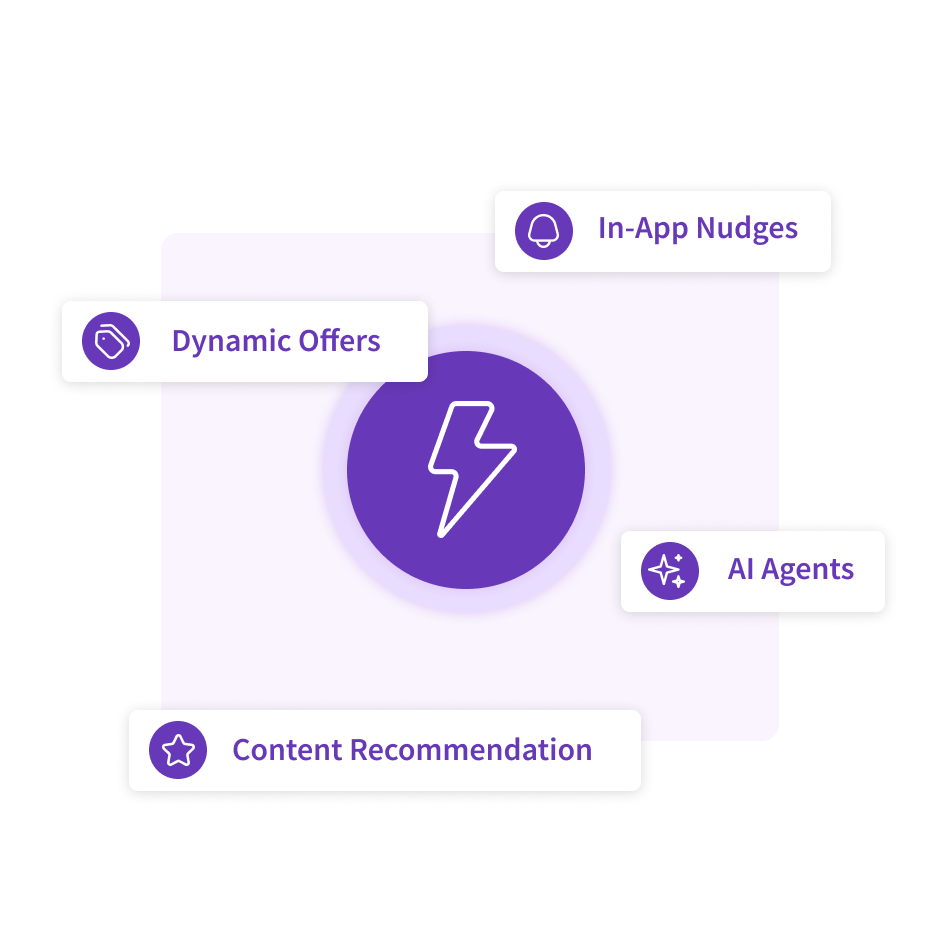
Take the right, personalized action for the customer to maximize the chance to reengage with real-time customer context available in real-time via Profiles, a database of calculated attribute values. Personalizing UI elements, offer dynamic pricing, or activate AI assistants with real-time interactions at key customer journey moments.
Real-time push notification, via server-side events
Proactive customer engagement exactly when it matters most
Take action, measure and iterate, via Snowplow tracking and warehouse analytics
.png)
Close the loop between trigger and outcome with stored behavior. Track what decision is taken, why, and what the customer state was at the time of interaction, directly into your data warehouse and lakehouse via Snowplow tracking. Analyze and optimize real-time triggers over time, driving systematic improvements in customer value.
Track real-time trigger performance with automatic attribution
A/B test different trigger conditions and engagement approaches
Identify which moments and actions drive meaningful business outcomes

Delivering dynamic digital experiences requires combining real-time behavioral data with historical customer context to personalize every interaction.
Dynamic Experience Types:
Infrastructure Requirements:
With Snowplow, brands collect comprehensive behavioral data across web, mobile, and server, then use Snowplow Signals to compute and serve user attributes in real time. Companies like Burberry use this infrastructure to power 40+ personalization models covering product recommendations, propensity scoring, and lifetime value prediction—enabling in-store advisors to personalize service based on online browsing behavior.
Triggering in-product experiences based on real-time events requires infrastructure that can capture user behavior, compute context, and deliver decisions to applications within milliseconds.
Technical Requirements:
In-Product Experience Examples:
With Snowplow Signals, product and engineering teams get real-time customer intelligence infrastructure designed for these exact use cases:
Snowplow Signals helps teams ship real-time personalization in weeks instead of years of custom infrastructure development.
Agile teams use real-time behavioral data to accelerate experimentation cycles, validate hypotheses faster, and make data-driven product decisions.
Real-Time Data in Agile Experimentation:
Faster Feedback Loops:
Data-Driven Decision Making:
Continuous Experimentation:
Strava Example: Strava's product team used Snowplow behavioral data to run A/B tests on their Routes feature. With real-time tracking and analysis through Snowflake and Tableau, they measured experiment impact with pinpoint accuracy—resulting in significant increases in Route page views, downloads, saves, and shares per user.
"With Snowplow data, we were able to measure project success through an A/B test... we delivered increased value to members of the Strava community." — Lauren Gray, Senior Product Analyst, Strava
With Snowplow, agile teams gain the real-time, granular behavioral data needed to experiment continuously. Snowplow's comprehensive tracking, real-time delivery, and dbt data models make it easy for product analysts to self-serve insights without waiting on engineering—keeping pace with rapid iteration cycles.
Companies personalize digital experiences at scale using event data by capturing granular, real-time behavioral signals from customer interactions. They can then transform them into actionable user attributes, and serve those attributes to personalization engines and AI systems with millisecond latency.
The modern event-driven personalization architecture:
Comprehensive behavioral data collection: Effective personalization requires capturing every meaningful customer interaction across touchpoints. This includes website navigation, content engagement, product views, search queries, cart interactions, feature usage, and conversion events. Snowplow enables teams to define custom events and entities that capture business-specific behaviors—not just generic pageviews—creating proprietary behavioral data that competitors cannot replicate. With 35+ SDKs and event tracking deployed across 2 million+ websites and applications, organizations collect comprehensive interaction data that forms the foundation for personalization.
Real-time event processing and enrichment: Raw events alone don't drive personalization; they must be enriched with context and transformed into meaningful signals. Snowplow's 130+ enrichments add geolocation, device fingerprinting, campaign attribution, bot filtering, and custom business logic in real-time as events stream through the pipeline. This creates rich, analyzable behavioral data immediately available for activation.
Feature engineering and profile computation: Personalization engines need computed attributes like "lifetime value," "propensity to churn," "content preferences," and "current session intent"—not just raw event logs. Modern infrastructure calculates these features in real time. Snowplow Signals specifically accelerates this through a streaming engine that computes user attributes continuously based on live, in-session behavior and historical context, enabling personalization that adapts within the same user session.
Low-latency profile access: Personalization systems need instant access to user attributes to customize experiences without latency. Snowplow Signals' Profiles Store API serves comprehensive user profiles with 45ms p50 response times, giving applications and AI agents the customer intelligence needed to personalize content, recommendations, UI elements, and agent responses in real time. This infrastructure replaces months of custom engineering to build profile serving layers.
Intervention and activation infrastructure: Once personalization decisions are made, systems need to deliver tailored experiences across channels. Snowplow Signals' Interventions engine pushes real-time customer interactions to personalization platforms, enabling adaptive UI updates, triggered messages, and dynamic content without building complex activation pipelines from scratch.
Scale and performance characteristics:
Organizations achieve personalization at scale through infrastructure that handles massive event volumes efficiently. Snowplow processes over 1 trillion events monthly with predictable costs since pipelines run in your own cloud infrastructure without per-event vendor fees. As event volume grows 100x, infrastructure scales linearly without pricing surprises or vendor constraints.
Proven personalization impact:
Research shows 3 in 4 consumers are more likely to purchase from brands delivering personalized experiences, and consumers will spend 37% more with brands that personalize effectively. Organizations using real-time customer experience methodologies retain 55% more customers, while companies with clean behavioral data report 28% email revenue increases from personalization improvements.
Why event-level data beats aggregated analytics:
Traditional analytics platforms like Google Analytics and Adobe Analytics provide pre-aggregated data that cannot power real-time personalization. They sample data, limit retention, and lack the event-level granularity needed for AI model training or complex user attribute computation. Snowplow delivers complete, unaggregated event streams with unlimited retention in your warehouse, providing the raw material for sophisticated personalization that platforms with black-box aggregation cannot support.
The Signals advantage for personalization teams:
Product and engineering teams building personalization capabilities face a stark choice: spend months or years building profile computation and serving infrastructure from scratch, or adopt Snowplow Signals to accelerate time-to-value. Signals provides the real-time customer intelligence infrastructure that eliminates data engineering overhead, allowing teams to focus on personalization logic and business outcomes rather than building pipes and databases. Development teams ship personalized experiences in weeks rather than years while maintaining complete control over their behavioral data foundation.
A next-best-action strategy is an approach in customer engagement where businesses predict and deliver the most relevant action or recommendation to a customer at a specific moment in their journey. This could be anything from offering personalized discounts, recommending products, or suggesting content based on previous behavior.
Using Snowplow's real-time data tracking, businesses can capture customer interactions across multiple touchpoints, allowing them to determine the best course of action for each customer, improving engagement and increasing conversions.
Create a live trial environment, send your first events, then work with it from your own coding tool through the MCP server or ask Snowplow Assistant in the console. No expert required, no credit card, no sales call.