Case Study
Autotrader Gains a Clearer View of High-Intent Car Shoppers
Snowplow Identities
Identities links anonymous and logged-in activity across devices, sessions, and domains as events move through your Snowplow pipeline. Personalization, attribution, and AI agents work from one user instead of several anonymous visitors.
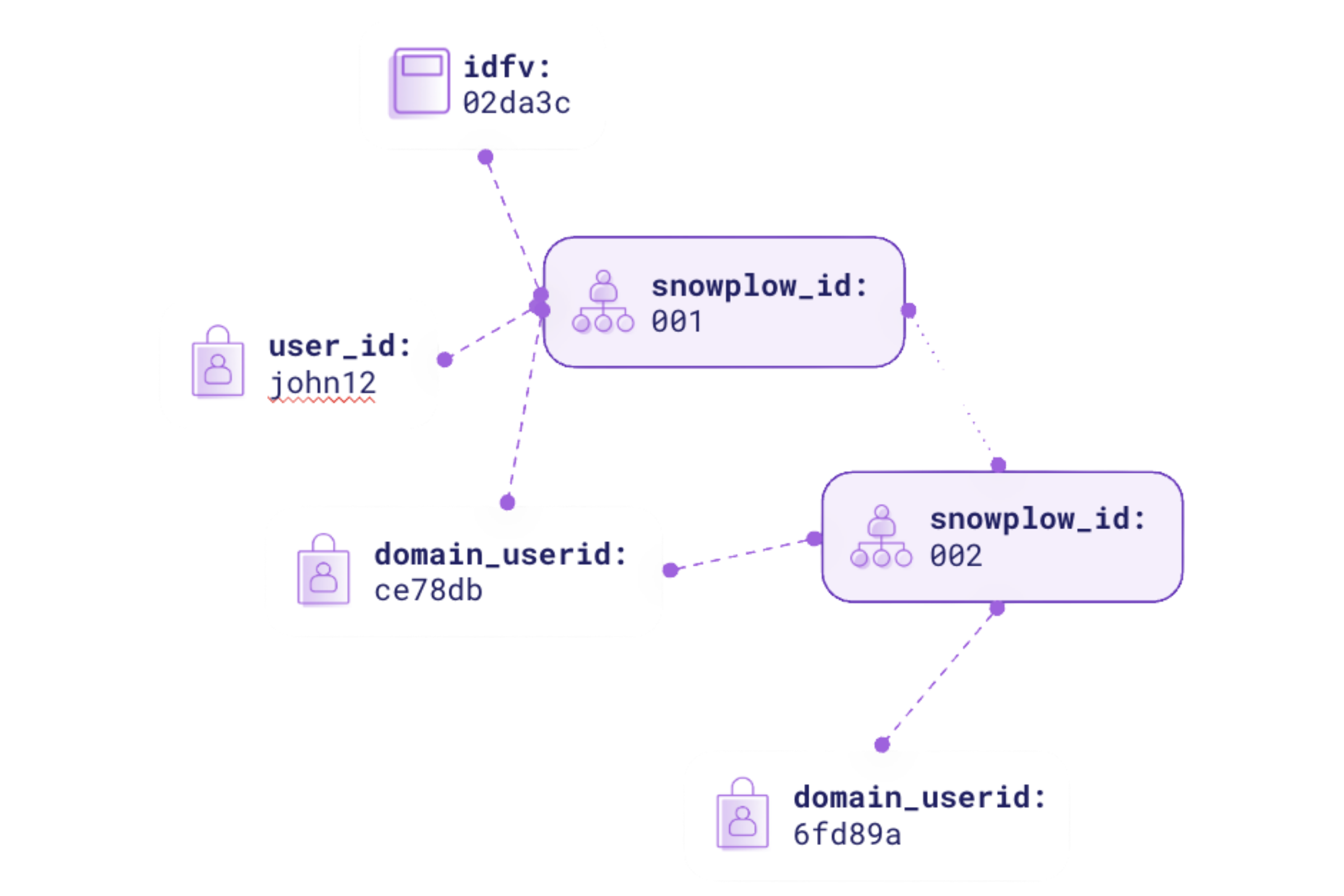
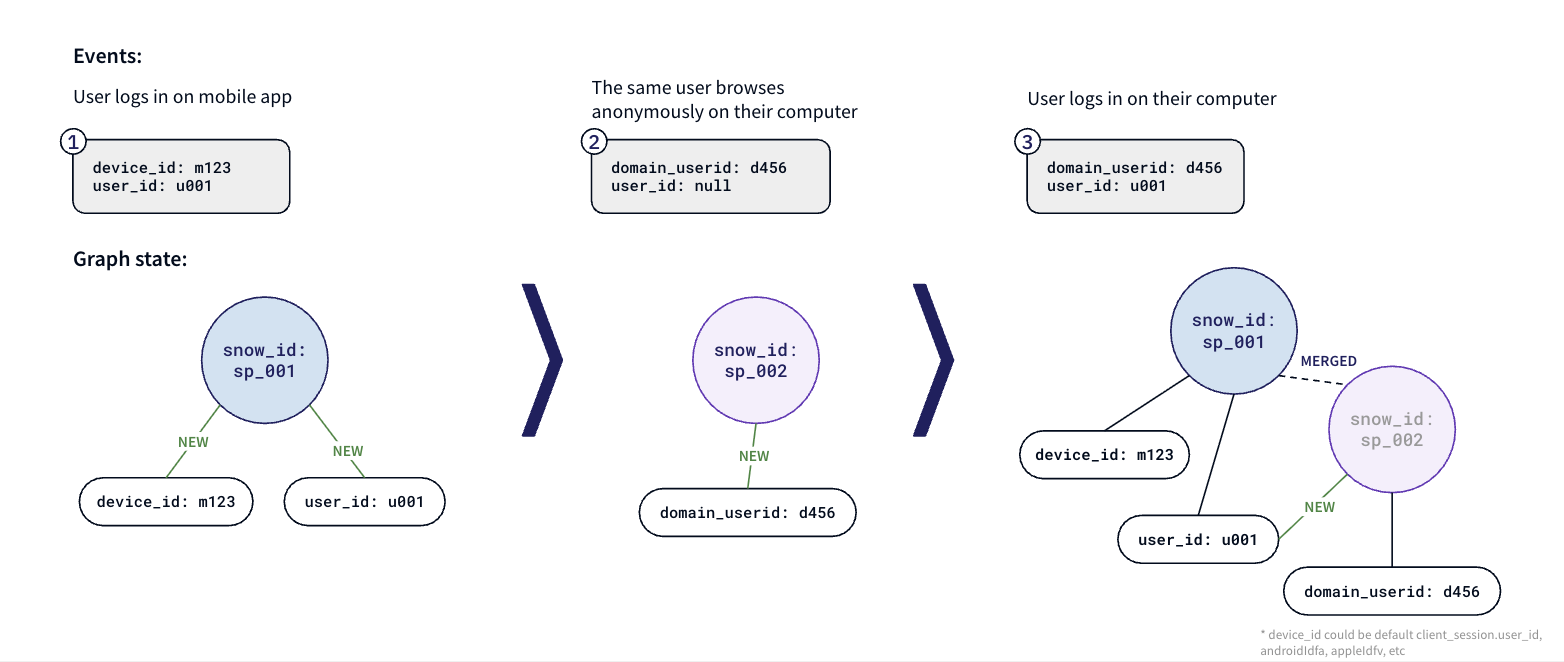
Most identity stitching runs after data lands in the warehouse. Until it does, one user looks like several anonymous visitors, and every system acting in the moment sees only part of the journey. Personalization can't use what the user did before logging in, at the point it could still change what they do next. Snowplow Identities closes the gap at login, while the user is still on your site, so you can act on the whole journey in real time.
Anonymous
Real-time identity gap
Known

Every event leaves the pipeline with a resolved Snowplow ID. Attribution, personalization, and AI agents see the current user without waiting for an overnight stitching job.

Identities links identifiers you already collect, from cookie and user IDs to hashed emails and custom fields. Every match is deterministic, with no third-party identity graphs.

The identity graph is deployed with your Snowplow pipeline. You set the rules and Snowplow runs the graph, so there's no stitching code to maintain.
Autotrader replaced a daily batch job with millisecond identity resolution. With stitched profiles, its purchase-intent model correctly identified 82% of shoppers who went on to contact a dealer, up from 63%.
"The Snowplow Identities product has helped us move from thinking about devices to thinking about people."


Identities runs as part of enrichment. Each event is checked against the identity graph and leaves the pipeline with a resolved Snowplow ID. Your warehouse, Snowplow Signals, and event forwarding destinations all see the same user.

Attribute anonymous pre-login activity to the logged-in user, in the same session or across sessions and devices
Connect web, iOS, and Android activity when users log in with the same credentials
Send identity-resolved events to your marketing and engagement tools with Event Forwarding
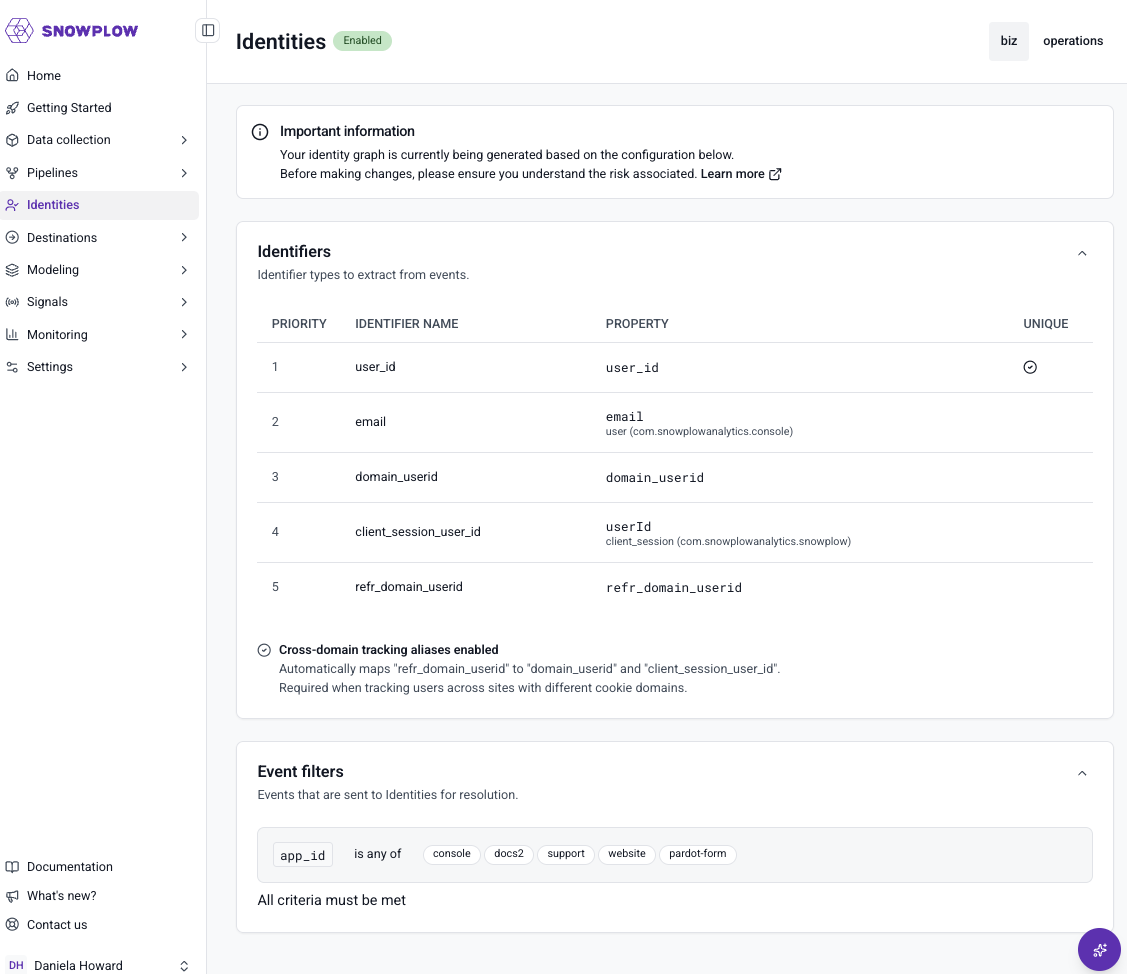
Choose the identifiers that define a unique user for your business, mark the one that must never merge, and filter which events get resolved. The graph handles the shared devices, repeated logins, and cross-domain journeys that break hand-written stitching jobs.
Keep people who share a device separate by marking an identifier, such as user ID, as unique
Follow users across your domains with cross-domain tracking aliases
Resolve on standard identifiers or any field in your events, such as a hashed email or custom user ID
The identity graph is deployed in the same cloud as your Snowplow pipeline, with no third-party data sharing. On Private Managed Cloud, that's your own cloud account. Resolved IDs flow into your warehouse and into Snowplow Signals for real-time features.
Fulfill GDPR erasure requests through the Identities API, with a dry-run preview first
Build identity mapping tables in your warehouse with the Identities dbt package
Track graph health in Console, including deduplication rate and identifiers per profile
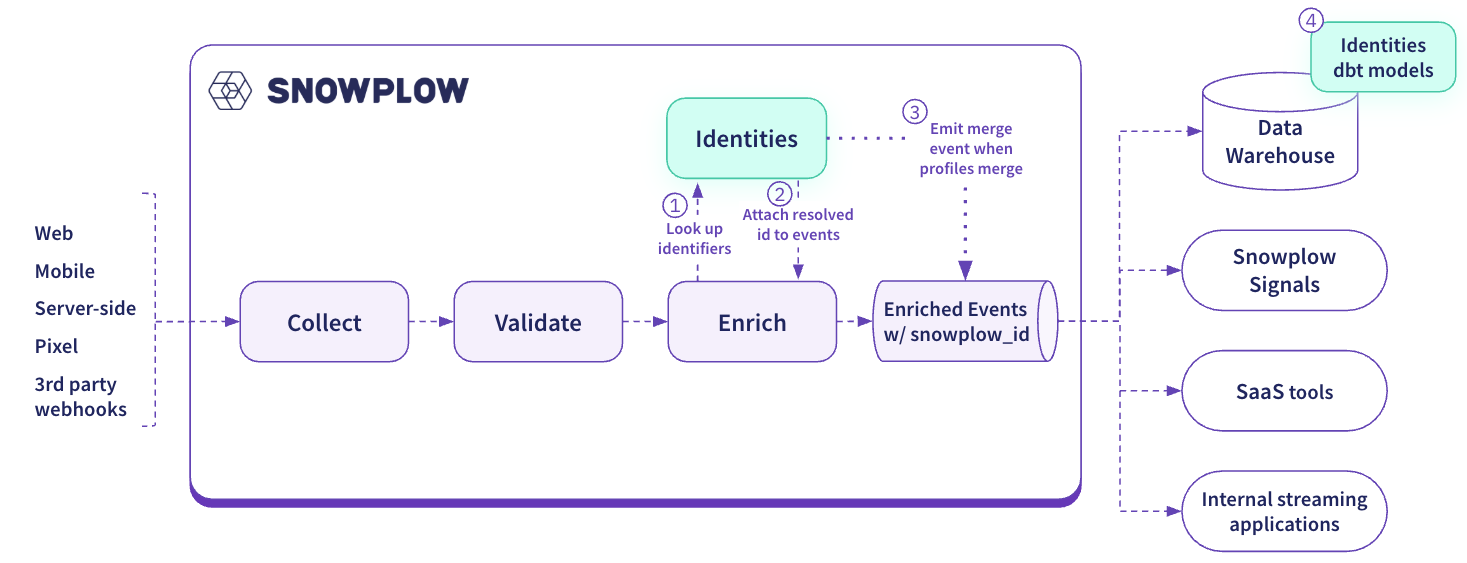
When identity is resolved outside the pipeline, every system acting in the moment works from partial data until it catches up. Each alternative trades away speed, ownership, or engineering time.
| Approach | Where identity is resolved | The tradeoff | With Snowplow Identities |
|---|---|---|---|
| Packaged CDPs | In the vendor's platform, on data its own SDKs collect | Identity data lives in another vendor's system, which limits ownership, governance, and architectural flexibility | Identity is resolved inside your Snowplow pipeline, with no separate collection layer or vendor profile store |
| Warehouse-native CDPs | In the warehouse, after data loads | Identity updates on warehouse batch cycles, so in-session uses like personalization are difficult to support | Identity is resolved in the event stream, and the same resolved IDs land in your warehouse for analysis |
| Identity graph specialists | In the vendor's graph, often with third-party data | Built mainly for advertising, with matches that depend on external identity graphs | Deterministic matching on your own first-party behavioral data, for product, analytics, and AI use cases |
| In-house builds | In stitching jobs your team writes and runs | Your team owns the graph logic, edge cases, and maintenance indefinitely, competing with the product roadmap | Snowplow runs the graph and your team configures identifiers. Autotrader tested an in-house streaming build against Identities, then retired the build. |

Snowplow Identities resolves identity as each event moves through your pipeline, so in-session uses like personalization see one user right away instead of waiting for a warehouse job, often run once a day. The same Snowplow ID lands in your warehouse, so your analysis uses it too. Your team chooses the identifiers and Snowplow runs the graph, so there's no stitching code to maintain.
Yes, Snowplow Identities resolves identity in your pipeline before data reaches Snowflake, so every event lands with its Snowplow ID, and merge events land alongside it. The Identities dbt package then builds identity mapping, identifier lookup, and audit tables in Snowflake. The same package also supports BigQuery and Databricks.
Identity resolution connects the different identifiers one person leaves behind, such as cookie IDs, logins, device IDs, and hashed emails, so their activity across devices, sessions, and sites counts as one user. Marketers use it for attribution, personalization, and audiences that reflect real people. Snowplow Identities does this in real time inside your Snowplow pipeline, matching deterministically on your own first-party identifiers.
When a user clicks from one of your sites to another with a different cookie domain, cross-domain tracking adds their browser ID to the link, and Snowplow Identities links both sites' IDs to the same Snowplow ID. You turn this on with cross-domain tracking aliases in the Identities configuration. It also works when users move from your mobile app into a webview. Their anonymous and logged-in activity resolves to one user.
Packaged CDPs resolve identity inside their own platform, on data their own tools collect, and warehouse-native CDPs resolve it after data loads, on batch cycles. Snowplow Identities resolves identity in your Snowplow pipeline as events arrive, so in-session uses see one user right away. The identity graph runs alongside your pipeline, and the same Snowplow IDs land in your warehouse for analysis.
Snowplow Identities only links the identifiers present in each event, so your consent setup decides what it can resolve. For visitors who haven't consented, Snowplow's anonymous tracking can leave out user identifiers and cookies. For right-to-erasure requests, the Identities API removes a person's identifiers and Snowplow IDs from the identity graph, with a dry-run preview first. You also delete their events from your warehouse and other destinations.
Snowplow Identities works without logins, but it connects different devices only when they share an identifier. It matches deterministically, so an anonymous visitor on a phone and the same person on a laptop stay separate until a shared identifier appears, such as a login, a hashed email from a form, or your own customer ID. Until then, it still connects a browser's visits over time and, with cross-domain tracking, across your sites.
Yes, Snowplow Identities can use any field in your events as an identifier, alongside standard Snowplow identifiers. That includes a hashed email from a sign-in form or a customer ID from your own user profile data. Choose identifiers that stay the same for a person and belong to only one person. Values that change often, or that many people share, such as IP addresses, weaken matching and raise costs.
Yes. The 14-day trial includes Identities, with limited resources that don't scale. Existing customers can contact us to add Identities to their pipeline.
Start a 14-day free trial and send your own events through Identities, or book a demo to map your identifiers, use cases, and deployment with our team.
No credit card required for the trial. Already a customer? Contact us to add Identities.