
Agentic Browsing Is Here. Is Your Analytics Stack Ready?
According to HUMAN Security, agentic browsing traffic grew 6,900% year-over-year from 2024 to 2025. Their usage is largely being driven by the rise of AI-powered browsers like Perplexity Comet and ChatGPT Atlas. These tools navigate websites, fill forms, and complete tasks on behalf of your customers. The concern is that most analytics tools can’t tell the difference between a human and an agent.
This post from Snowplow, which is developing an AI agent detection and analytics solution that identifies what traditional analytics tools architecturally cannot see, explores the hidden risks of agentic browsing for data, analytics, and marketing leaders. We also uncover why your metrics may already be compromised. This post follows on from the first blog in our agentic browsing series: ‘What is An Agentic Browser?’
Agentic browsing data is valuable, but it’s currently tangled together with human behavioral data. As a result, your metrics are telling a mixed story. The likes of Google Analytics 4 can't reliably distinguish AI agents from human visitors. Instead, both platforms rely on bot filtering lists designed for an era when bots self-identified. Chromium-based agentic browsers break that paradigm entirely.
In this post, we’ll cover the two types of AI agents visiting your site, why traditional analytics tools can’t see them, the business risks of flying blind, and practical steps to start untangling your data.
Your Analytics Data Is Tangled
The visibility problem with agentic browsing differs by agent type, and understanding this distinction is critical.
In-browser agents like Perplexity Comet, ChatGPT Atlas, and Dia run JavaScript and inherit the user’s session. They show up in your analytics, but they’re nearly indistinguishable from humans using standard methods. When Atlas browses the web, it presents a standard Chrome user-agent string identical to any human visitor. GA4’s IAB bot list doesn’t catch it. These agents do trigger engagement events like mouse movements and clicks. They have to in order to interact with pages. But HUMAN Security research shows these events exhibit non-human patterns such as linear movements, consistent timing, and movements in precise 0.25-pixel increments that sophisticated behavioral analysis can detect.
These agents don’t trigger engagement events (no mouse movements, scrolling, or keyboard activity), but neither do bounced human users, making detection complex.
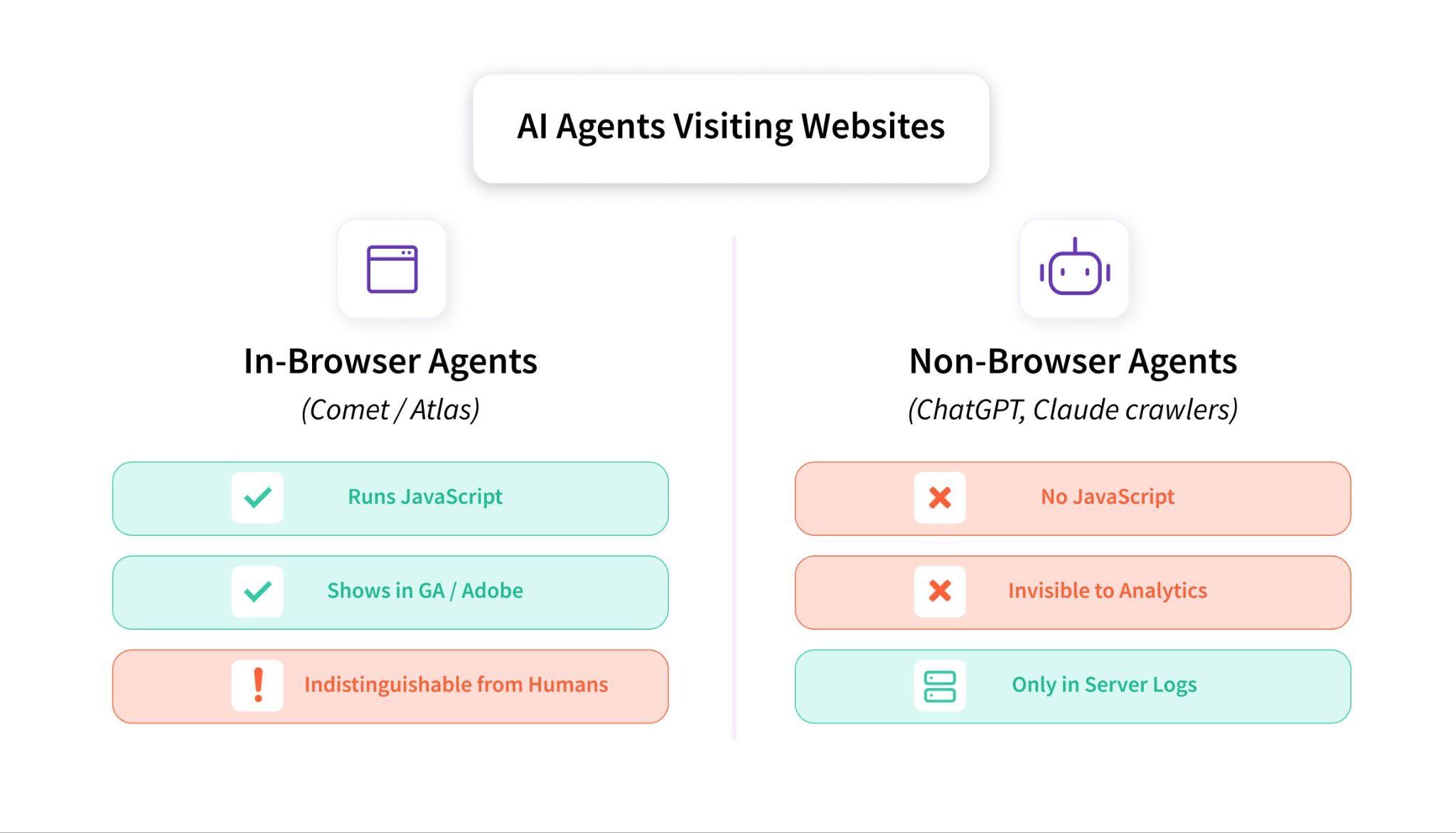
Non-browser agents, like those answering questions in ChatGPT or Claude, for the most part don’t run JavaScript at all. They fetch content directly from their own servers using identifiable user-agent strings (GPTBot, ClaudeBot). They’re completely invisible to traditional analytics tools. You’ll only see them in server logs, which most companies don’t integrate into their analytics workflows.
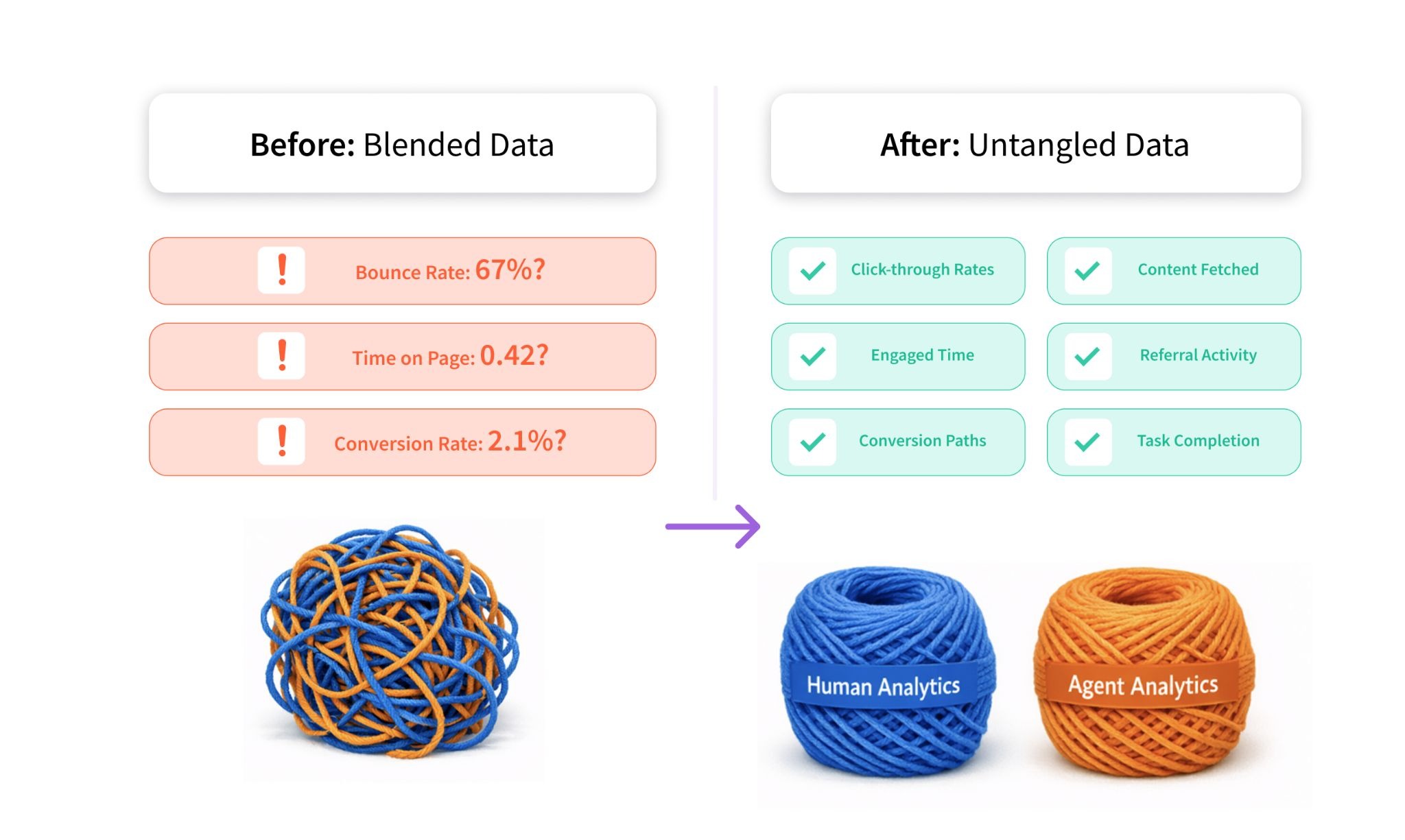
The lack of effective agentic analytics solutions out there has led to companies operating with tangled data. To describe this, we use the analogy of a ball of thread that needs separating. In there, you have human analytics (click-through rates, engaged time, conversion paths) and agent analytics (what they fetch, referral activity they generate). Right now, both are knotted together, making your metrics misleading.
Let’s consider how agentic browsing distorts analysis by use case:
Conversion rate optimization: You need different approaches for agents versus humans. AI agents can complete tasks. For example, if a user asks an agent to book a flight, it may finish the transaction, all while ignoring promotions and upsells entirely. In our experiments with Perplexity Comet, we observed the agent dismissing an on-site chatbot instantly, stating: “I see there is a pop up, let me close it.”
Media and ad measurement: Advertisers want to reach people, not AI agents. If you’re a media company inflating engagement numbers with agentic browsing traffic, you risk losing advertiser trust and ad revenue. We dive into this issue in more detail in our guide for media and entertainment leaders: ‘The Invisible Audience Costing You Millions.’
Bounce rate and time on page: When an AI agent visits a product page to compare prices, your analytics sees a bounce with zero engaged time. But that agent may have analyzed the page and passed detailed information to the user. The “bounce” was actually valuable research that could lead to a purchase.
The Business Risks of Flying Blind
When you can’t see or distinguish agentic browsing traffic, you make decisions that hurt your business without knowing it.
Wasted optimization effort: You see a high bounce rate and invest engineering resources into page improvements. But if you could untangle the data, you might discover your true human bounce rate is much lower. The elevated number was actually driven by AI agents that behave differently.
Misguided A/B tests: AI agents don’t respond to visual design changes the way humans do. If your test cohort includes both populations without segmentation, your results become uninterpretable. You’ll want to run tests on humans or agents separately.
Content invisibility: For non-browser agents that don’t run JavaScript, your content may be completely invisible if it requires client-side rendering. These agents will simply promote your competitors. This has driven adoption of pre-rendering CDN services that serve static HTML to AI agents.
Customer disintermediation: When an AI agent engages with your site on behalf of a user, it can easily swap you for a competitor if your multi-step workflows don’t work well for automated navigation. As BCG warned: “Without intervention, retailers risk being reduced to background utilities in agent-controlled marketplaces.”
Why Detection Is Hard
The technical challenge of distinguishing agentic browsing from human browsing is more complex than traditional bot detection.
Let’s consider what happens when a user hands off to an AI agent mid-session. A customer visits your site. They log in, browse their account, and then prompt an agentic browser to renew their subscription. The browser takes over. Your analytics sees one continuous session. The issue is, traditional analytics tools can’t detect this handoff. Only sophisticated behavioral analysis can reveal the sudden shift from erratic human patterns to the agent’s efficient, linear movements.
In this scenario, what changes would you see in the behavioral data? The browsing pattern shifts from human to machine-like. With human users, you’ll see them wandering across the page. You’ll see irregular scrolling and indirect paths. Agentic browsers, on the other hand, navigate directly to target elements with consistent timing. They behave efficiently and purposefully, goal-directed rather than exploratory.
Standard bot detection fails because agentic AI browsers are fundamentally different from traditional bots. Old-school bots run in the cloud (blockable by IP), use scraping frameworks (detectable via WebDriver fingerprinting), and self-identify via user-agent strings. Agentic browsers run on the user’s machine, inherit legitimate logged-in sessions, and use standard Chrome user-agents. They don’t need automation frameworks. Instead, they sit inside a normal browser that can already complete tasks across any website.
There is one positive thing to note here. ChatGPT Agent now includes cryptographic signatures (RFC 9421 HTTP Message Signatures) that allow websites to verify its identity. Sites can check for a Signature-Agent header and validate against OpenAI’s public key. However, not all agentic browsers have adopted this standard, and most websites haven’t implemented verification.
Agentic browsing detection therefore requires both event-level behavioral data (patterns within engagement events, not just their presence) and client-side fingerprinting. Even if agents simulate mouse movements in the future, they have no incentive to wander aimlessly like humans. The whole point of these tools is real-time task automation.
What You Can Do About It
The path forward differs by agent type. Non-browser agent detection is more established. In-browser agentic browsing detection is still emerging.
For non-browser agents: Start examining your server logs or server-side events. These agents don’t run JavaScript and won’t appear in GA4. Once you quantify this traffic, decide your response. So you may want to block specific crawlers, allow them, negotiate agreements with AI platforms, or optimize yield by adding pre-rendering CDN platforms that serve complete content to AI agents.
For in-browser agents: No comprehensive solution exists today. At Snowplow, we are developing an approach that combines CDN integration for server-side events with client-side fingerprinting and behavioral pattern analysis within sessions. This will allow our customers to look for the absence of human-like engagement patterns to identify when an agent has taken over.
Looking ahead: Businesses may need to rethink UX entirely. Agentic browsers navigate directly to goals, ignoring promotional content along the way. Strategic options include serving abridged content when agentic mode is detected, implementing captchas, optimizing for price comparison, or targeting users with dynamic interventions at the moment they take back control from the agent.
See Perplexity Comet in action: navigating sites, completing tasks, and highlighting the challenge of agentic browsing for analytics.
The Analytics Blind Spot That's Only Getting Bigger
You can’t optimize for what you can’t see. Agentic browsing is here, and your analytics data contains two completely different visitor types: humans and AI agents. The problem is they’re currently being analyzed as if they’re the same audience. Now is the time for businesses to start untangling this data to understand their true conversion rates, run meaningful A/B tests, and optimize experiences for both humans and the intelligent assistants acting on their behalf.
The shift to agentic browsing is accelerating. The question isn’t whether it will affect your business, it’s whether you’ll see it coming.
See How Snowplow Solves Agentic Browser Detection