
What Is an Agentic Browser?
AI agents can now browse websites, compare products and services, and purchase on behalf of humans, fundamentally disrupting how people interact with the web. But traditional analytics tools can’t detect the difference. Here's what businesses need to know about agentic browsers.
Agentic Browser: Definition
An agentic browser is a web browser that embeds AI agents built on top of large language models (LLMs). These agents can interpret natural language commands, autonomously navigate websites, fill out forms, and complete tasks on a user’s behalf. Unlike traditional browsers that only display web pages and rely on manual clicking, agentic browsers can plan and carry out sequences of actions across multiple websites with minimal user intervention.
Key Takeaways
- Commercial Intent: Agentic browsers like Perplexity Comet, ChatGPT Atlas, and Gemini in Chrome can browse, compare products, and complete purchases autonomously on behalf of users
- Explosive Adoption: Traffic from agentic browsers grew by over 1300% from January to August 2025, driven by the shift from experimental tools to mass-market releases
- Accelerating Growth: The latest figures suggest the trend is speeding up with agentic browser traffic jumping another 131% month-over-month from August to September 2025
- Blind Spots: Google Analytics can't distinguish between human visitors and AI agents. Your data is already compromised
- High Value: 87% of AI agent page visits are product-related, signaling genuine commercial intent that you might be missing or misattributing
Your next website visitor might not be clicking anything. They might not even be looking at your page.
With the rise of agentic browsing, AI-powered browsers like Perplexity Comet, ChatGPT Atlas, and Gemini in Chrome can navigate web pages, fill out forms, compare products, and complete web tasks, all on behalf of a human user. This isn't automation in the traditional sense. Agentic browsers use intelligent AI agents that reason, adapt, and act autonomously to accomplish goals across multiple websites.
Throughout early 2025, this traffic was primarily composed of open-source agents used for testing or developer tools. That changed rapidly in Q2 and Q3.
According to data from HUMAN Security, agentic traffic grew by 1,300% between January and August 2025, reaching nearly 4.5 million requests per month. This surge was largely driven by the July releases of major commercial tools like ChatGPT Agent and Perplexity Comet.
Crucially, this adoption is accelerating, not stabilizing. Following those major releases, total AI agent traffic increased by another 131.15% month-over-month from August to September 2025. With 87% of these visits being product-related, this represents a massive wave of commercial intent that legacy analytics tools are currently counting as "users."
How Agentic Browsers Work
Traditional web browsers like Chrome, Safari, Firefox, and Edge require you to do all the work. You start by conducting a search, evaluate results, click links to websites, read or view content across multiple web pages, then manually complete desired actions. In contrast, agentic browsers compress this entire multi-step workflow into a single instruction.
Agentic AI browsers don’t follow pre-programmed scripts. Instead, they use advanced reasoning to adapt to different websites in real time. Here’s how this works:
Intent interpretation: The AI agent analyzes your natural language command to understand the desired outcome and breaks it down into actionable steps. So let’s say you ask it to “Book a dinner reservation for Friday night.” This request becomes a series of tasks that the AI agent fulfills. It will find restaurant options, check availability, compare times, and complete booking forms.
Website analysis: When carrying out these tasks, the agent scans web page structure, identifying interactive elements like buttons, forms, links, and navigation menus. It understands both visual layout and underlying code.
Action planning: Based on your intent and the page structure, the agent creates a step-by-step execution plan that may span multiple websites.
Execution with adaptation: The agent carries out actions while monitoring results. If something unexpected happens, such as when a form requires additional fields or a button doesn't respond, it adapts its approach in real time.
Result validation: After completing the task, the agent verifies success and reports back.
This is completely different from scripted automation. Agentic browsers reason through problems, handle unexpected scenarios, and learn from interactions.
The Agentic Browser Landscape
Several agentic browsers are already reshaping how people interact with the web. To name a few:
The market projections underscore the scale of this shift: the agentic AI market is estimated to reach $140.8 billion by 2032.
Why This Matters for Businesses
Most companies today still rely on traditional analytics tools like Google Analytics. But these tools were built for an era where every web page visit and click was human.
These tools capture page views, clicks, and form submissions while assuming every session is a person sitting at a screen making decisions. That assumption is now broken.
When an agentic browser visits your site, your analytics platform doesn’t know the difference. It counts the session, logs the page views, and may even record a conversion. But it can’t tell you whether that was a human user or an AI agent acting on their behalf. Worse still, it can’t tell you when a session switches from human to agent mid-stream. Your analytics sees one continuous session, missing entirely when the behavior shifted from human decision-making to autonomous execution.
As a result, your digital KPIs are lying to you, and your strategic decisions are compromised with polluted data:
- Conversion rates mask two fundamentally different audiences, human users and AI agents, each requiring different optimization strategies
- A/B tests produce false results because agents don't respond to visual design changes the way humans do
- Attribution models break when the "user" comparing products on your site is actually Perplexity Comet gathering data for a human who never visits directly
- Engagement metrics become misleading when a “highly engaged session” might indicate either a captivated human reader or an agent systematically parsing your content
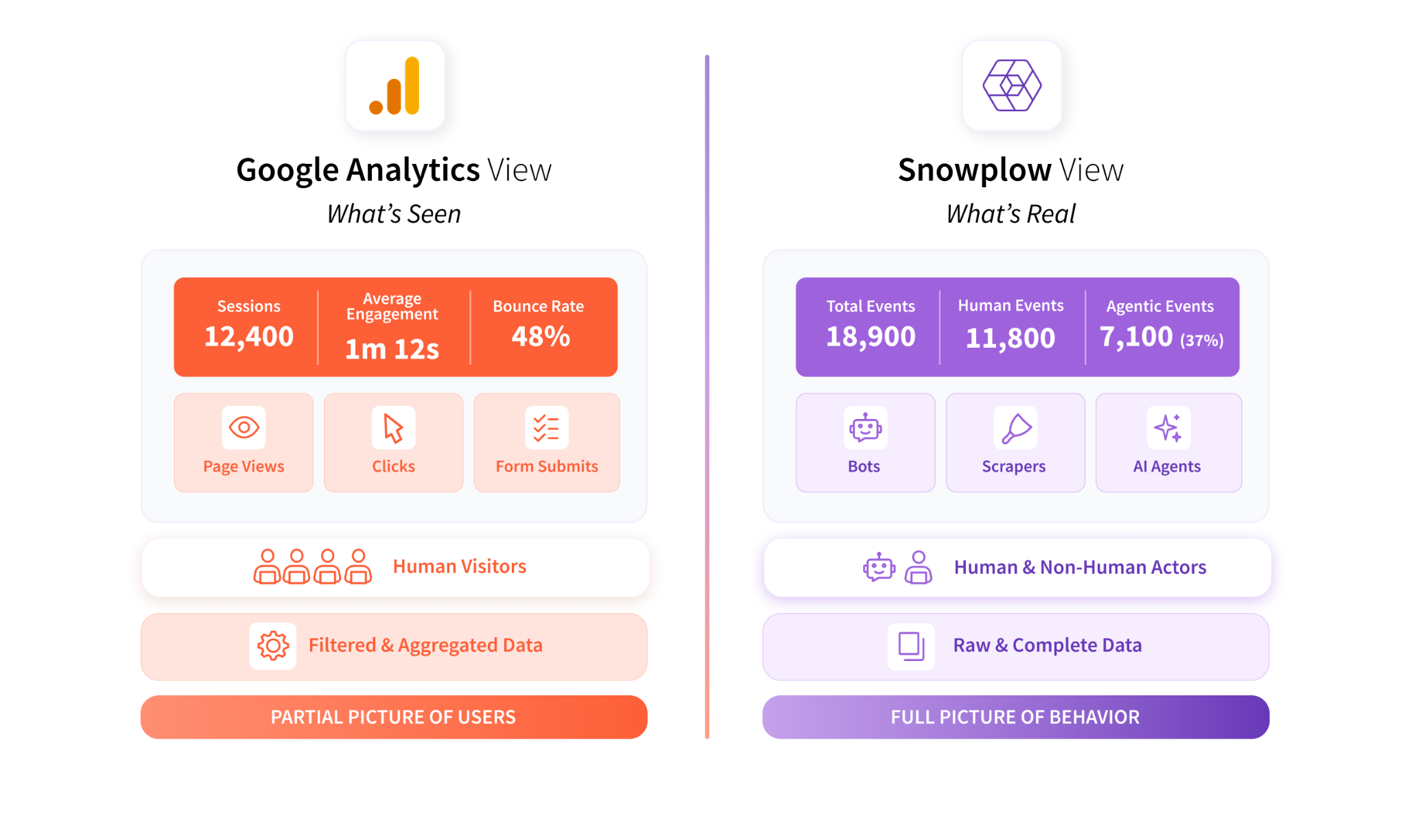
You may think that agentic browsing is still in its infancy and this issue isn’t urgent. But the current numbers surrounding agentic browsing are staggering:
- 1,300% increase in agentic traffic from January to August 2025 (HUMAN Security)
- 87% of agent page visits are product-related, signaling real commercial intent
- Over 50% of consumers expect to use AI shopping assistants by end of 2025
For your business to succeed, your analytics needs to be able to answer: How much of my traffic is actually human vs. AI agents? Which visitors—human or agent—are driving revenue? And how do I optimize experiences for each audience?
Detecting Real-Time Behavioral Shifts: The Half-Human, Half-Agent Problem
Here's where it gets technically challenging. With agentic browsers built into tools like ChatGPT Atlas and Perplexity Comet, a single session can shift from human to agent mid-stream.
For example, let’s say a real user visits your website, logs in, and browses their account. They then prompt the built-in agent to renew their subscription and skip any upsells. The agent takes over, navigating your site on the user’s behalf.
You now have a session where half the behavior was human and half was AI-driven. Differentiating the two is quickly becoming one of the hardest problems in digital analytics today.
Why? Because traditional analytics tools like Google Analytics see one continuous session. They weren’t built for this complexity and can’t distinguish between human visitors, AI agents acting for users, and crawlers gathering training data.
Three Types of AI Traffic and Why Each Demands a Different Response
Not all AI traffic hitting your website is the same. It’s important for you to understand the spectrum so you can respond appropriately:
- Training crawlers: AI companies crawl websites to train large language models. These behave like search engine crawlers, indexing your content for future use.
- Answer-fetching agents: When users ask ChatGPT or Claude questions, these AI agents retrieve information from websites in real time to generate responses. This is where Generative Engine Optimization matters. You want your content surfaced when people ask questions in AI chat interfaces.
- Agentic browsers: These execute web tasks on behalf of users. They browse, compare, fill forms, and complete purchases. This is true agentic browsing whereby AI agents perform complex web interactions autonomously.
Each type requires a different response. You might gate training crawlers, optimize for answer-fetching agents, and ensure agentic browsers can navigate your site effectively.
The Real Business Impact: What You Lose When AI Agents are Invisible
In case you’re still wondering why this all matters for your business, here are some real-world scenarios that showcase the impact of not identifying agentic browser traffic:
Two-sided Marketplace: Your supply-side partners are complaining that lead quality has dropped, but your internal metrics show engagement is up. The reality? Agentic browsers are querying your site to compare options across multiple marketplaces by checking availability, prices, and reviews without genuine booking intent. Meanwhile, your recommendation algorithms are trained on this mixed data, so they're optimizing for agent behavior patterns instead of actual customer preferences. Your sellers see inflated impressions but declining conversions, eroding trust in your platform.
E-commerce: A shopper asks ChatGPT Atlas to "find the best running shoes under $150 with good arch support." The agent visits six retailer sites, compares products, reads reviews, and recommends a competitor. Your analytics logged the session, including page views, time on site, and products viewed, but because your product pages weren't optimized for agent comprehension, you ranked lower in the comparison. You lost the sale without knowing you were in the running, and your e-commerce analytics team attributes the "bounced" session to poor user experience rather than agent-based comparison shopping.
SaaS: Your free trial conversion rate dropped 15% this quarter. Your product-led growth team is panicking, testing new onboarding flows and burning engineering resources on A/B tests. But the real issue? AI agents are signing up for trials to gather product information for comparison reports. They were never going to convert. They were just polluting your funnel metrics. Meanwhile, your product team is optimizing for the wrong audience, and you're unable to calculate true customer acquisition costs (CAC) because you can't separate legitimate prospects from agent-driven research sessions.
Media & Entertainment: Your "engaged readers" metric is up 40%, but subscription conversions are flat. Why? A significant portion of that "engagement" is answer-fetching agents scraping your content to power AI responses elsewhere. Your premium content is being consumed, just not on your site, and not by paying subscribers. Meanwhile, your editorial team is creating content based on inflated engagement signals, and you're unable to prove content ROI to advertisers when you can't distinguish between human readers and AI agents.
Financial Services: Your product comparison pages are seeing record traffic, but applications for credit cards and loans haven't increased. AI agents are systematically crawling your rates, terms, and eligibility requirements to populate comparison tools and AI financial advisors. Meanwhile, your marketing team celebrates high engagement on product pages while conversion rates plummet. Engineering resources are wasted running A/B tests on application flows that mix human and agent behavior into the same cohort, making it impossible to identify what's actually happening.
The competitive risk is existential. Agentic browsers are creating a new layer of disintermediation between you and your customers. As BCG warns: "Without intervention, retailers risk being reduced to background utilities in agent-controlled marketplaces." If AI agents can't navigate your site effectively, they'll recommend competitors instead. And you won't even know it happened.
What Digital Businesses Should Do Now
The agentic browsing shift isn't theoretical; it's happening now, and the gap between leaders and laggards is widening fast. Companies that can detect, analyze, and respond to AI agent traffic will capture value from this new interface between businesses and customers. Those that can't will be filtered out by agents before customers ever see them.
Here are four steps to get ahead of the agentic browser wave:
1. Segment your traffic: Create distinct classifications for humans, bots and crawlers, answer-fetching agents, and agentic browsers. Each requires different treatment. To achieve this, you need granular, event-level data with full request details, which is something GA's aggregated, sampled data can't provide. Snowplow captures the raw behavioral data needed to identify and classify agent traffic at the event level.
2. Understand before you act: You can't optimize for agent traffic until you can see and measure it. Without knowing which visitors are agents versus humans, what type of agent they are, and what they're doing, you can't make informed decisions. While standalone agent-detection tools exist, they create another data silo, separating agent traffic from your broader behavioral data. Snowplow tracks and delivers complete, unsampled event data directly to your own warehouse, lake, or stream, giving you full ownership and control. Unlike closed analytics platforms that black-box their data processing, Snowplow lets you build sophisticated agent detection models, customize classification rules, and quickly adapt your approach as new agent types emerge.
3. Invest in real-time behavioral data infrastructure: Agentic browsers operate fast. Your data infrastructure needs to keep pace and capture these interactions as they happen, not in aggregated reports hours or days later. Because Snowplow tracks and delivers behavioral data in real time, you can identify agent sessions mid-stream, trigger different experiences for agents versus humans, and adapt your strategy based on what's happening right now
4. Design for both audiences: The web now has two types of visitors: humans who browse visually and agents who parse data programmatically. Sites that serve both will win. Snowplow’s real-time AI agent detection and digital analytics capabilities reveal how each audience navigates your site so you can optimize for both.
The Bottom Line
Agentic browsers represent a fundamental shift in how people interact with the web. AI browser agents that can navigate sites, compare products, fill out forms, and complete web tasks autonomously aren't a future concept. They're here now, with adoption accelerating rapidly.
The companies that will thrive are those who can see what's really happening on their sites. Without the ability to distinguish human behavior from AI agent behavior, you're making strategic decisions based on increasingly unreliable data. Your competitors who solve this first will optimize for both audiences while you're still flying blind.
The first step is visibility. You can't optimize what you can't see, and you can't see agents with tools built for a different era.
At Snowplow, we're helping businesses detect and understand AI agent traffic while establishing a complete real-time behavioral data foundation that’s needed to optimize web experiences for agentic browsers, as well as to provide real-time context to your own customer-facing AI agents.
See How Snowplow Solves Agentic Browser Detection
Frequently Asked Questions
What is an agentic browser?
An agentic browser is a web browser enhanced with AI agents that can autonomously navigate websites, fill out forms, and complete tasks on behalf of users. Unlike traditional browsers that require manual clicking and navigation, agentic browsers use large language models to interpret natural language commands and execute multi-step workflows automatically.
What is the difference between an agentic browser and a traditional browser?
Traditional browsers like Chrome, Safari, and Firefox display web pages and wait for user input. Every click, scroll, and form submission requires human action. Agentic browsers use AI to actively perform tasks on your behalf. You tell the browser what you want to accomplish in plain language, and it handles the navigation, form-filling, and task completion autonomously.
What are examples of agentic browsers?
The main agentic browsers currently available include Perplexity Comet, ChatGPT Atlas (OpenAI), Opera Neon, Dia (from The Browser Company), and Fellou. Each offers different capabilities, from conversational browsing and booking flights to deep research automation and memory-driven task assistance.
Are agentic browsers safe to use?
Agentic browsers introduce new security risks alongside their productivity benefits. Key concerns include prompt injection attacks (where malicious web content hijacks the agent), exposure of sensitive data during automated form-filling, and reduced visibility for security teams. The UK National Cyber Security Centre has advised caution for enterprise adoption. Users should review privacy policies carefully and avoid using agentic browsers for highly sensitive transactions until the technology matures.
How do agentic browsers affect website analytics?
Agentic browsers create significant challenges for analytics teams. Traditional analytics tools like Google Analytics cannot distinguish between human visitors and AI agents acting on their behalf. This breaks standard metrics like engagement rates, conversion funnels, and attribution models. Additionally, sessions can shift from human to agent control mid-stream, making it difficult to understand true user behavior. Without the ability to detect and segment agent traffic, businesses are making decisions based on polluted data—mixing two fundamentally different audiences into the same metrics.
Why are agentic browsers important for businesses?
Agentic browser traffic to retail sites increased 4,700% year-over-year in 2025, and 87% of AI agent visits are product-related. These represent real customers with genuine purchase intent. Businesses that can't see or understand agent traffic risk losing sales to competitors whose sites work better for AI agents. Companies need to detect agent traffic and optimize their websites for both human visitors and the AI agents acting on their behalf. Those that can't risk being filtered out of agent recommendations entirely.