


Agentic commerce is on every retail leadership agenda, and it is hard to plan for, because the term is used for five different things. A shopper who asks ChatGPT what to buy and then clicks through to your site is one. A personal agent that fills a basket for its owner is another. A checkout inside an assistant, a stylist agent on your own site and two agents agreeing a price are three more. They move at different speeds, sit with different teams and need different decisions.
This post separates the five. For each one it sets out what is happening today, the question it puts in front of a retailer's leadership team, and what the answer depends on. In every case the answer depends on customer data, which is why an agentic commerce strategy is, underneath, a data strategy.
Shoppers ask AI what to buy, and some now let it buy
Discovery moved first. In September 2026, visits to US retail sites that came from AI assistants converted 90% better than other traffic, generated 83% more revenue per visit, and grew 71% year on year (Adobe, October 2026). In Europe, 38% of shoppers in France, Germany and the UK already use AI when researching or deciding on a purchase (McKinsey, March 2026).
Until this autumn, delegation had not followed. In May, at most 11% of US consumers said they would let AI make a purchase decision (Gartner, May 2026). OpenAI retired single-item Instant Checkout in ChatGPT in March, six months after launch (Modern Retail, March 2026).
Then, on 8 September, Meta launched Muse, a personal agent that researches, compares and buys for its owner, asking for approval before it pays. Agents that buy were not new: Amazon, Perplexity and OpenAI had each shipped one. Muse is the first to reach a mass audience. On Meta's third-quarter earnings call, Mark Zuckerberg said more than 10 million people in the US and Canada had set up Muse in six weeks, that shopping is its most common use, and that more than a quarter of the people using it shop with it, at an average purchase of over $200 (Meta, 21 October 2026). Those are Meta's own figures. Independent measurement points the same way: HUMAN Security saw eight times as many agent requests in October as in August, 60% of them to e-commerce sites and 59% of them from Muse (HUMAN Security, November 2026).
Two cautions belong next to those numbers. Agents still browse far more than they buy: under 2% of the requests HUMAN counted reached a checkout or payment page. And Muse is not yet available in Europe. A European retailer has some time, and a US retailer has less.
The five layers
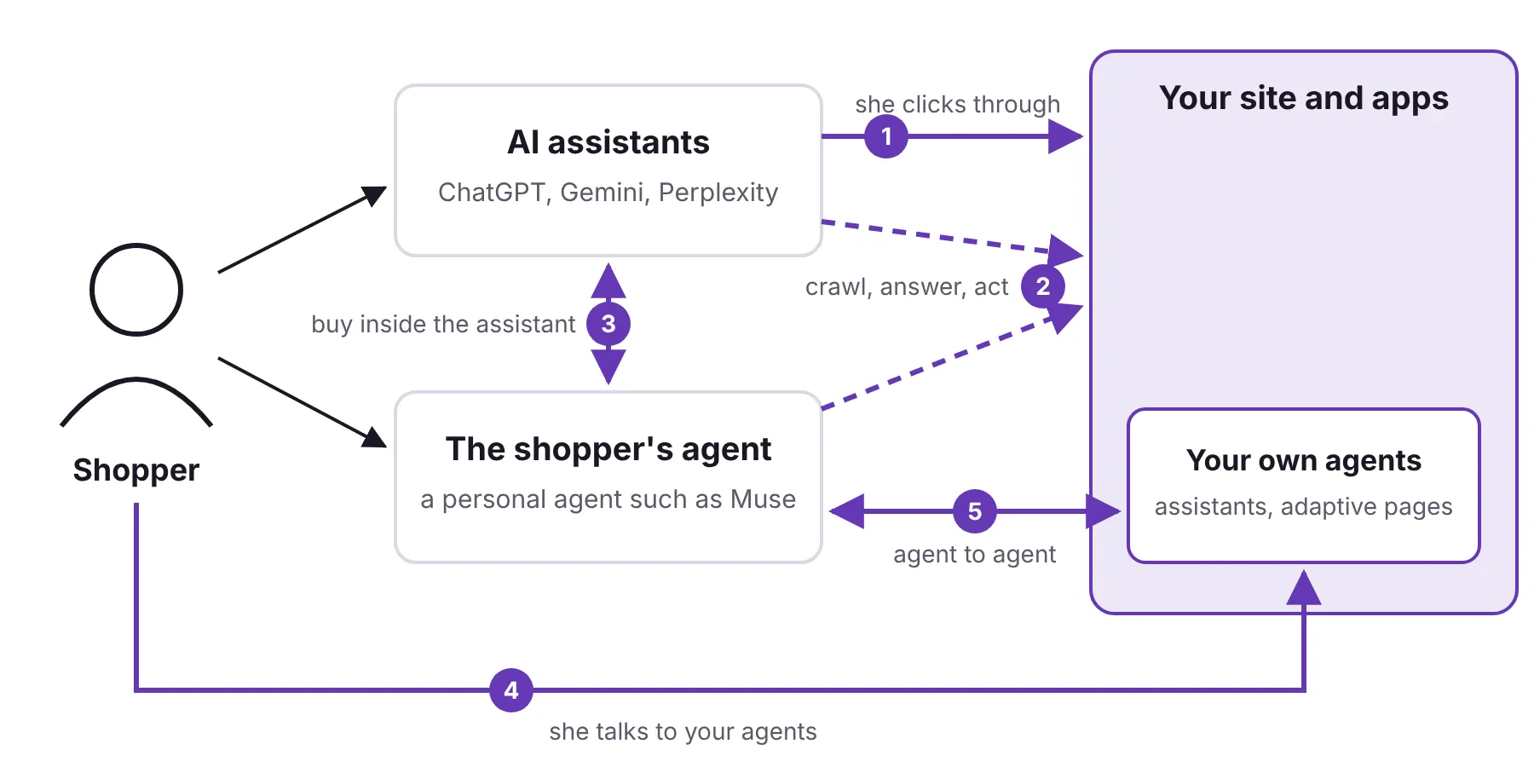
- AI-referred shoppers. She asks an assistant, clicks through and buys on your site. Live everywhere. Small, growing fast, and the only layer with conversion data.
- Agents visiting your site. AI agents crawl your pages, fetch them to answer a question, or shop for their owner. Live, growing fastest, and mostly invisible.
- Agentic checkout. The purchase completes inside the assistant. Live in the US. The first attempt was rolled back and the second keeps the retailer in charge.
- Your own agents. Assistants, stylists and service agents, then pages that adapt to each visit. Live at leading retailers, and the layer with the most upside.
- Agent to agent. The shopper's agent deals with yours. The payment rails exist and the first protocols have been previewed.
1. AI-referred shoppers: a new channel that reports as "direct"
This is the only layer where a retailer already has volume and conversion data. The share of traffic is small and growing fast, and early evidence says many of these shoppers are new. Walmart has said ChatGPT brings it new customers at about twice the rate of search engines (PPC Land, citing Wired, March 2026). Etsy reported fifteen-fold growth in AI-referred traffic and said it was still less than 1% of the total (Digital Commerce 360, April 2026).
Most of this traffic is hidden. In our own tests this autumn, ChatGPT did not consistently pass a referrer or a UTM parameter, even on product links, so click-throughs arrived as direct traffic. Gemini answers often name brands with no link at all, so the visit that follows shows up as organic search or direct.
Illustration from travel: a family fare, from a link-free answer
Priya asks Gemini how to get a family of four from Manchester to Lisbon for the February half term. The answer names three airlines, with no links. She types one airline's address into her browser.
| Time | What she does | What the site reads |
|---|---|---|
| 0:00 | Lands on the homepage. No referrer, no cookie. | New visitor. Reported as direct traffic. No history to draw on. |
| 0:20 | Searches Manchester to Lisbon, 2 adults and 2 children, 13 February. | A family trip on school-holiday dates. |
| 0:45 | Opens the baggage allowance page, then the seat map. | Worried about bags and about sitting together. |
| 1:10 | Returns to the fare results. | The results now lead with the fare that includes seats together and one checked bag, and say why. |
Everything the airline knows about Priya, it learned in the last seventy seconds. For a first-time visitor sent by an assistant, the session is the whole profile.
The question for leadership. Is AI referral a channel in your business, with an owner, a number and a target, or is it sitting inside "direct"? And do you judge it on conversion rate or on new customers? In categories where shoppers browse, an AI-referred visitor may convert below average, because she arrives with no account and no history. It may still be a strong source of new customers, which only your own data can show.
What the answer depends on. One definition of AI referral applied across every assistant and rebuilt over your history, so the trend is visible. Those visits joined to orders, margin and repeat purchase, so you can say what a customer from an assistant is worth. And in-session behavior that is readable within seconds, so a first visit like Priya's can be served well.
2. Agents visiting your site: some of them are customers
AI agents visit retailer websites for three different reasons. They crawl pages to train a model, with no person waiting. They fetch pages to answer a question right now, while a person reads the answer instead of the page. Or they act for a person: browse, compare, fill the basket and, with approval, pay.
The first two decide whether you appear in the answer at all. Most of them never run your JavaScript tracker, so your analytics never sees them, and many product pages are hard for them to read. Adobe scored apparel product pages as 51% machine-readable, the second-lowest category it measured (Adobe via Digital Commerce 360, June 2026).
The third kind is a customer, and since September it is the fastest-growing kind. Muse gives each user a browser in the cloud, opens product pages directly and does not consistently declare itself, so the visit looks like a person on desktop Chrome and is counted as direct traffic (Botify, 2026). Before Muse, a UK marketplace told us it filtered ChatGPT's self-declared browsing visits out of its analytics as bot traffic. Those visits came from people who wanted to buy something.
Retailers have already made opposite choices. Amazon blocked Muse within two weeks of launch (GeekWire, September 2026). Shopify opened Shop Pay checkout to it across its merchants' stores (Implicator, September 2026). Each choice fits the company that made it. Amazon has its own shopping agent and an advertising business that depends on shoppers arriving in person. Most retailers have neither.
Illustration from consumer electronics: an agent and its owner share one visit
Daniel wants a laptop for video editing, under €1,800. He asks his personal agent to compare three models on an electronics retailer's site, where he has bought before.
| Time | What happens | What the site reads |
|---|---|---|
| 0:00 | The agent starts browsing, logged in as Daniel. | An agent acting for a known customer. |
| 0:05 | It opens 14 product pages in 85 seconds, reads the spec tables and ignores the banners. | An acting agent. Serve structured specs, stock and delivery dates. Keep these events out of human conversion metrics. |
| 1:40 | It adds one laptop to the basket and asks Daniel to approve. | Control has passed to the human in the same visit. |
| 2:10 | Daniel opens the basket. | The basket shows the comparison his agent made, plus the dock that fits the monitor he bought here last year. |
Most analytics would count this as one very fast and very odd human session, and plenty of bot rules would block it. It is a customer buying a laptop.
The question for leadership. Which agents do you welcome, which do you turn away, and who in the business decides? This is a commercial decision about customers, and in many retailers it is currently made as a security setting. A related question follows: when an agent shops for a customer, what do you want it to find?
What the answer depends on. Knowing, event by event, whether a person, a bot or an agent is on the site, and for acting agents, which customer they act for. Seeing the crawlers and answer bots that never run JavaScript, which means capturing requests at the CDN. And joining agent visits to products and orders, so the decision to welcome or block is made on revenue. Agents that do not declare themselves make the first of these hard today, which is one more reason to start measuring before the volume arrives.
3. Agentic checkout: who owns the sale?
The first attempt at checkout inside the assistant did not work. Walmart said shoppers who bought inside ChatGPT converted at a third of the rate of those who clicked through to its site (Modern Retail, citing Wired, March 2026).
The pattern that replaced it keeps the retailer in charge. ASOS's Stylist app in ChatGPT completes the purchase on asos.com (ASOS, May 2026). Etsy dropped Instant Checkout and launched its own app (TechCrunch, May 2026). Google's Universal Commerce Protocol, launched with Shopify, Walmart, Target, Etsy and Wayfair, keeps the retailer as seller of record (Google, January 2026). Shoppers seem to prefer it that way: they trust a retailer's own agent three times more than a third-party one (Bain, May 2026).
Illustration from beauty: "the usual", with one question first
Ana is running low on foundation. She asks her AI assistant to reorder "the one I always get" from a beauty retailer. The assistant opens the retailer's app inside the chat, and Ana links her account.
| Time | What happens | What the retailer reads |
|---|---|---|
| 0:00 | The retailer's app opens inside the assistant. Ana signs in. | The same customer across the assistant, the site and the store. |
| 0:10 | She asks for "the usual". | Shade 24N, bought every eight to ten weeks, last bought eight weeks ago. |
| 0:12 | The app asks: your usual 24N, or the 22N you looked at twice on our site last week? | Recent browsing that points to a seasonal shade change. |
| 0:40 | She picks 22N and pays with her saved details and loyalty points. | The order is flagged as having come through an agent. |
The assistant found the product. The retailer made the sale, kept the customer and avoided a likely return, because it knew her history and what she had done on its own site last week.
The question for leadership. When a sale starts in someone else's assistant, what are you prepared to hand over, and what do you keep? The answer most retailers are reaching is to be present inside the assistants and keep the basket, the customer record and the loyalty program on their own side.
What the answer depends on. One identity for the customer across web, app, store and agent. Her recent behavior available to the app inside the assistant in seconds. And agent-originated orders marked as such in the warehouse, so the channel can be measured.
4. Your own agents: the layer you control
The web made the customer do the work: search, filter, compare, read the size guide. An agent turns that around. She explains what she wants and the experience responds. Today that mostly means an assistant added to the existing site. The next step is bigger: a fast model reads what the shopper has done, on this visit and before, and decides what the page shows, in what order, with what message.
This is the one layer where the retailer sets the pace, and where a strong brand gains most, because what makes it different in a store can carry into its digital experience. It is also the layer that depends most on context. An assistant that does not know who the shopper is, or what she did two minutes ago, is a search box with a friendlier tone.
Illustration from grocery: one homepage, three visitors
The same grocer's homepage could compose itself differently for three visitors, from what it knows about each.
| Visitor | What the page shows | Context it read |
|---|---|---|
| A household that changed this month | "Midweek plant-based dinners", with their usual oat milk back in stock, smoked tofu on offer, and chicken thighs off their regular list with an undo. | Three years of weekly orders. Meat removed from two baskets in the last 14 days, tofu added twice, and a search for "high protein vegan" in this session. Two weeks of behavior outweigh three years of it. |
| A first visit, sent by an AI answer | "20-minute dinners for four", picking up from where the question left off, with a recipe box, kid-friendly flags and delivery tonight. | No history. Landed on a quick family dinners page with no referrer, 40 seconds after an answer bot fetched the same page, so probably AI-referred. Opened two recipes in 30 seconds. |
| An agent doing the weekly shop | A structured basket built from the household's own rules: items, prices, stock, allowed substitutions and their default delivery slot. No banners. | An agent acting for a known household, with the household's saved substitution rules and its recent shift to plant-based. Its events stay out of human conversion metrics. |
The question for leadership. If the page could respond to each visitor, which part of your experience would you rebuild first, and how would you know it worked? The retailers moving fastest pick one journey, build it and measure it against a control group.
What the answer depends on. Customer context that an agent can read: who she is across channels, what she has done in the last few minutes, and what she has done before, computed as the events arrive. Complete product attributes, because an assistant cannot answer a question about an attribute that was lost on the way into the catalog. And the agent's own actions recorded as events, so what it changed can be measured.
5. Agent to agent: what does your agent know that a competitor's cannot?
The rails for agents dealing with agents are being laid. Mastercard launched Agent Pay for Machines in June (Genfinity, June 2026), and Visa, Mastercard and Ant International agreed in September to make their agent-identity protocols work together (Biometric Update, September 2026). In October, Meta previewed a protocol for Muse to talk to businesses' agents, with Walmart, Shopify and Stripe among the partners (Meta, 21 October 2026). Zuckerberg described the direction on the same call: "if you want to buy something, it's not just navigating to that business' website. It's talking to their agent."
Volume is still very low. The illustration below is a sketch of where this could go, not a description of something live.
Illustration from home and furniture: two agents agree a sofa
Sam's agent is looking for a three-seat sofa under £1,500, delivered before 18 December, not velvet (Sam returned a velvet chair last year). It contacts the seller agents of three furniture retailers.
| Step | What happens | What the retailer's agent reads |
|---|---|---|
| 1 | Sam's agent asks for options that meet the brief. | Stock in the nearest warehouse, delivery slots left before 18 December, return rates by model. |
| 2 | The seller agent proposes a sofa, and a bundle with the matching armchair at a member price. | Sam viewed that armchair three times this week. The bundle price is within the margin rules. |
| 3 | Sam's agent takes the sofa, declines the chair and books 15 December. | The declined bundle is recorded as an outcome for the next offer. |
| 4 | Payment settles between the agents, with Sam's consent on record. | An agent-to-agent order, attributed like any other. |
The other two retailers' agents had the same catalog and similar prices. What set this one apart was what it knew about Sam.
The question for leadership. When a shopper's agent asks three retailers for an offer, why would yours win? Price and catalog are easy for an agent to compare, so they stop being an advantage. What is left is what you know about the customer and how quickly your agent can use it.
What the answer depends on. The same customer context as layer 4, served to an agent that can make an offer within rules the business has set, and a record of every offer and outcome.
An agentic commerce strategy is a data strategy
Read the five "depends on" paragraphs together and the same three questions come up each time:
- Who is visiting? A person, a bot or an agent, and which customer the agent is acting for.
- What is she doing right now, and what do we already know about her? This session, in seconds, combined with everything learned across web, app and store, in a form an agent can read.
- What happened, from crawl to order? Crawl, answer, click and order in one place, joined to revenue, so each layer can be measured and agent traffic stays out of the models that learn from customer behavior.
A retailer that can answer those three has choices in every layer: it can see the new channel, decide which agents to welcome, keep the sale, build its own agents and give them something to say. A retailer that cannot is making each of those decisions blind, or having them made for it by the assistants.
Most retail data stacks were built for reports read the next morning. Priya's fare page, Daniel's basket and Sam's sofa are all decided while the customer, or her agent, is still there.
Where Snowplow fits
Snowplow is a customer context layer. It collects what shoppers, and the agents acting for them, do on a retailer's site, apps and servers. It validates every event against definitions the retailer wrote, and delivers the data with its meaning attached to the warehouse and to the agents that need it, the minute it lands.
For layers 1 and 2: Snowplow flags bot traffic, and Agent Intelligence classifies agents that identify themselves by operator and, where known, by purpose. AI-referred visits are classified as such whenever the assistant passes a referrer or UTM. Capture at the CDN brings in crawlers that never run JavaScript, and all of it is joined to products, orders and revenue in the warehouse.
For layer 4: Snowplow Signals computes what the shopper is doing right now, combined with what is known from her history, and serves both to the retailer's agent. It fires interventions when a shopper or an agent meets a condition, and tracks the agent's own actions back as events, so the team can measure what the agent changed.
For layers 3 and 5: the customer record and the identity that any checkout protocol or seller agent will need, whichever vendor supplies the surface.
Snowplow does not replace the CDN, the personalization vendor, the service agent or the checkout. It sits underneath them, as the record of who the customer is and what she did that every one of them needs.
Five questions for the leadership team
- Is AI referral a channel with an owner and a number, and what is a customer from an assistant worth to us?
- Which agents do we welcome, which do we turn away, and who decides?
- When a sale starts in someone else's assistant, what do we keep?
- Which experience would we rebuild first if the page could respond to each visitor?
- When a shopper's agent asks three retailers for an offer, why would ours win?
None of them needs a five-year plan. The first two can be answered with data most retailers could have within weeks, and the answers make the other three easier. The space is moving quickly: six months ago shoppers were not delegating purchases, and millions of them now are. Retailers that can see what is happening on their own sites will be able to move with it.
We are working through these questions with retailers now. If you are too, we would like to compare notes.